

Oil prices rose again on Tuesday as the conflict between the United States and Iran intensified. Major Asian stock markets posted losses and Wall Street futures traded lower amid growing uncertainty about the global crude supply and the economic impact of the war in the Middle East.
Brent crude topped $84 per barrel after rising nearly 10% on Monday, while the U.S. benchmark increased 1.4% to $79.20 per barrel.
Although oil remains below the near-$120-per-barrel highs seen in previous conflicts, the market is focused on the Strait of Hormuz after both the United States and Iran said they control that strategic route for global energy trade.
Tensions rose following new U.S. strikes on Iranian territory, after President Donald Trump said Washington is “re-establishing” a blockade on Iran in the Strait of Hormuz.
Clashes in the region also disrupted maritime transport. The interruption of tanker transits through the strait hampered deliveries of crude from the Persian Gulf to international markets and pushed fuel prices higher.
The worsening geopolitical outlook also hit Asian stock markets. In Japan, the Nikkei 225 fell 1% to 66,574.96 points, while South Korea’s Kospi dropped 3.2% to 6,589.37 points.
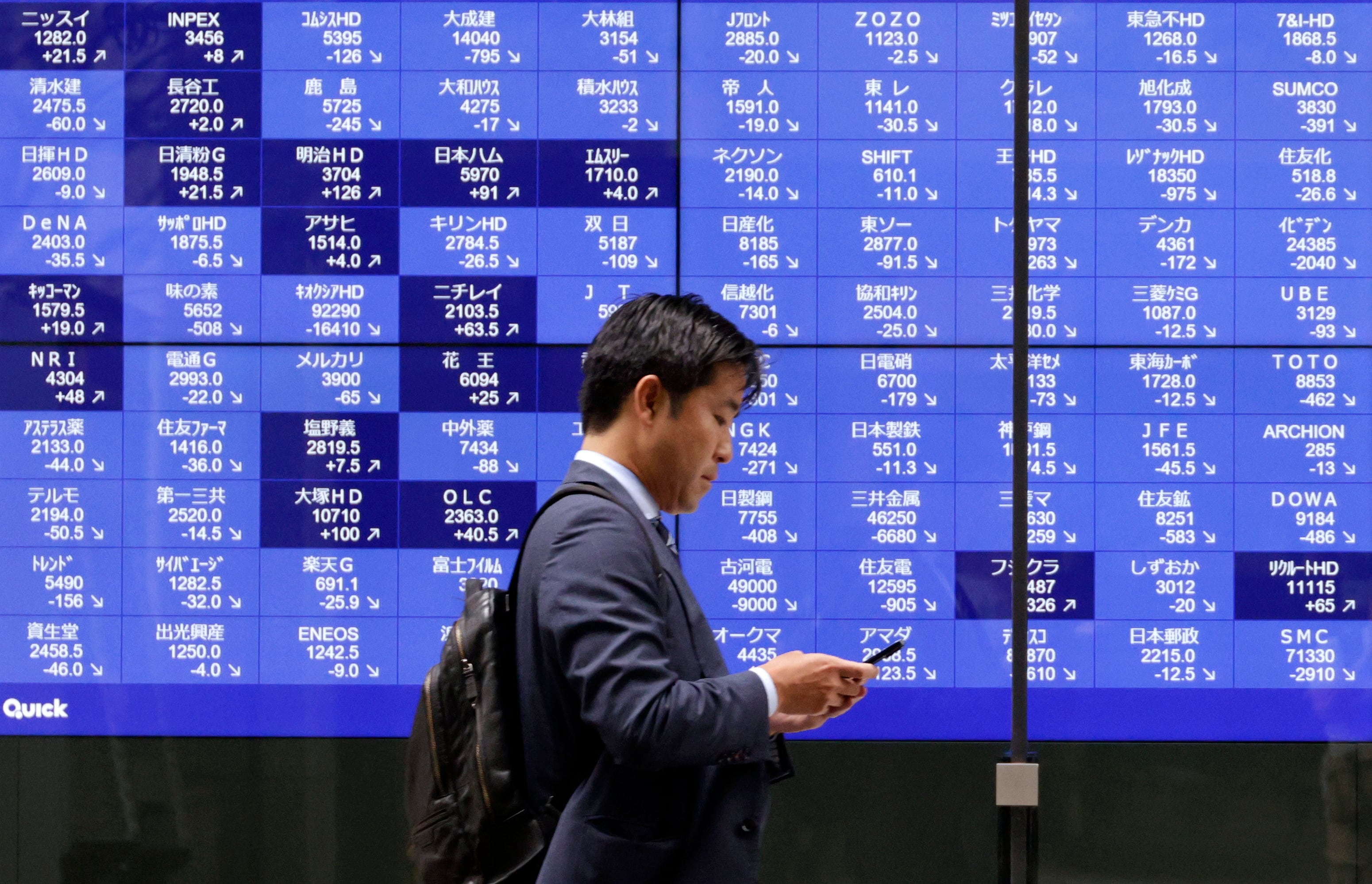
In China, the Shanghai Composite fell 0.8% to 3,884.32 points, despite government data showing exports grew 27% in June compared with the same month a year earlier.
The increase in external sales was driven by strong demand for semiconductors and other technology products linked to the expansion of artificial intelligence.
By contrast, Hong Kong’s Hang Seng rose 0.1% to 24,230.46 points, while Australia’s S&P/ASX 200 slipped 0.5% to 8,767 points.
Pressure was also felt on Wall Street. On Monday, the S&P 500 dropped 0.8%, after completing four positive weeks out of the last five. The Dow Jones Industrial Average fell 0.3% and the Nasdaq Composite declined 1.6%.
The largest losses were concentrated in companies linked to artificial intelligence. Micron Technology shares fell 4.4%, although the company still has a year-to-date gain of 243.1%. Nvidia declined 3.5% and, because of its large market capitalization, was one of the main sources of downward pressure on the S&P 500.
Investors also remain cautious about technology valuations amid the possibility that artificial intelligence may not deliver the level of profits and productivity the market expects.

Traders will focus this week on second-quarter corporate earnings reports. On Tuesday, Bank of America, Citigroup, JPMorgan Chase, Goldman Sachs and Wells Fargo are scheduled to release results that will serve as benchmarks for U.S. corporate profit trends.
FactSet projects that companies in the S&P 500 will report average earnings growth of 23.6% year over year for the quarter. If confirmed, that would be the second consecutive quarter with growth above 20%.
Analysts say companies will need to sustain strong growth to justify the high share prices reached, especially after significant gains in recent months.
At the same time, higher oil prices could push up inflation and increase pressure on the Federal Reserve and other central banks to raise interest rates. Higher borrowing costs typically help control prices but can also slow economic activity and affect the value of various financial assets.
In the currency market, the dollar traded at 162.34 yen, compared with 162.35 yen in the previous session, while the euro rose to $1.1391 from $1.1381.
(With information from Associated Press)