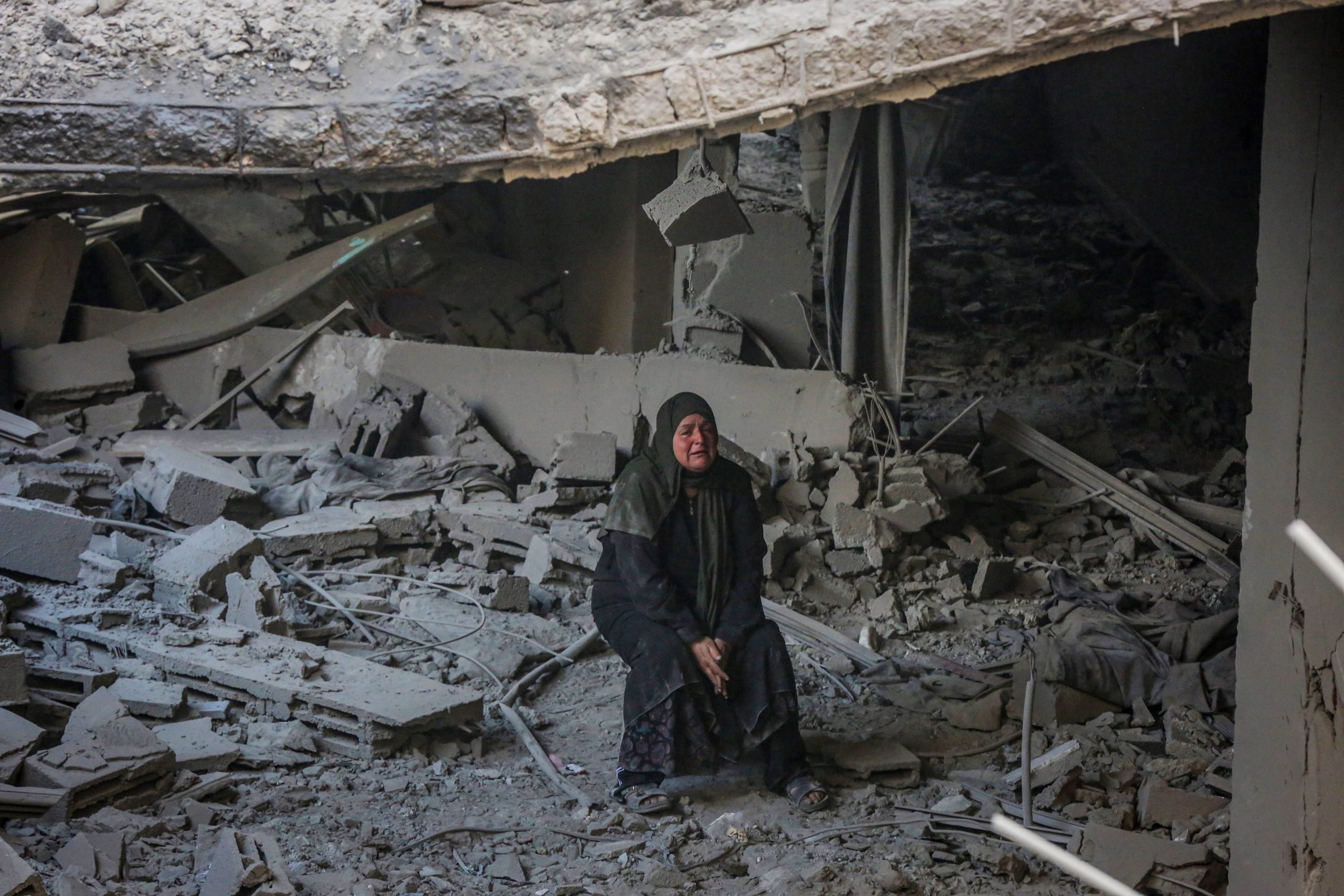
Image: Palestinians inspect heavy damage to buildings after an Israeli air strike on the Al-Shati Camp in western Gaza City, Gaza, on May 9, 2026. (Photo by Saeed M. M. T. Jaras/Anadolu via Getty Images)
Episode: Ghada Karmi: How Gaza Shattered the Myth of Coexistence (Spotify episode embed)
Overview
The program asserts that Israel’s war on Gaza has destroyed longstanding hopes for Palestinian-Israeli coexistence and revealed the international systems that have supported decades of Palestinian dispossession. In a special Marc Steiner Show episode marking the Nakba anniversary, Marc Steiner interviews physician and author Dr. Ghada Karmi about the destruction in Gaza, the erosion of faith in political solutions, and the deepening sense of despair among Palestinians and some Israelis.
Key facts cited in the episode
– Since October 7, 2023, the program reports that 73,000 Palestinians have been killed, including more than 20,000 children, and that much of the land and infrastructure have been devastated.
– The episode is dedicated to the Nakba, the 1948 displacement event when nearly a million Palestinians fled or were forced from their homes and many became refugees.
Guest
Ghada Karmi — Born in Jerusalem and displaced during the Nakba, Karmi trained as a doctor at Bristol University. She founded the first British-Palestinian medical charity (1972), was an Associate Fellow at Chatham House (the Royal Institute for International Affairs), and has written several books including the memoir In Search of Fatima and One State: The Only Democratic Future for Palestine-Israel. Her recent novel is Mojana, set in medieval Baghdad.
Credits
– Producer: Rosette Sewali
– Studio Production: Cameron Granadino
– Audio Post-Production: Stephen Frank
Transcript note
The program provides a rushed transcript that may contain errors; a proofread version will be made available later.
Summary of the conversation (neutral, condensed)
Marc Steiner opened the conversation by framing the episode around the Nakba and the ongoing violence since October 2023. He described the human toll and displacement and invited Karmi to assess the current moment for Israel and Palestine.
Ghada Karmi said she considers the present situation worse than the Nakba she experienced in 1948. Where she once held hope that Israel might not permanently endure in its current form, she now doubts the possibility of a shared future under present conditions. Karmi has long advocated a single, democratic state with equal rights for all, and she reaffirmed the centrality of the Palestinian right of return. At the same time, she said it is increasingly difficult to ask Palestinians to accept living alongside a population many of whom, she argued, now support violent policies against Palestinians.
On coexistence and comparisons with other cases, Karmi rejected simple analogies to South Africa, noting differences in demographics and historical context and arguing that many Jewish Israelis are settler-colonists in her view. She said reconciliation or a one-state solution would require either willingness by Jewish-Israelis to accept equal citizenship or their departure — outcomes she now sees as unlikely given public opinion and political developments.
Karmi identified international support — especially from Western governments and the United States — as a critical factor sustaining Israel’s current policies. She suggested several scenarios that could change the situation: a significant shift in international support, a larger regional conflict (for example involving Iran or Hezbollah) that makes the cost of continued policies unsustainable, internal fractures within Israeli society, or growing global public pressure. She also expressed concern about the risks posed by Israel’s nuclear capability in extreme circumstances.
Throughout, Karmi conveyed deep pessimism about the short-term prospects for Palestinians and Israelis under current conditions, while emphasizing the need to continue advocating for a just outcome and for Palestinian return. Marc Steiner reiterated the importance of continuing efforts toward peace and invited further conversation about Karmi’s recent work.
Closing
Marc Steiner thanked Dr. Karmi for joining the program and noted links to her extensive publications. Listeners were invited to share feedback at mss@therealnews.com.
Leave a Reply
You must be logged in to post a comment.