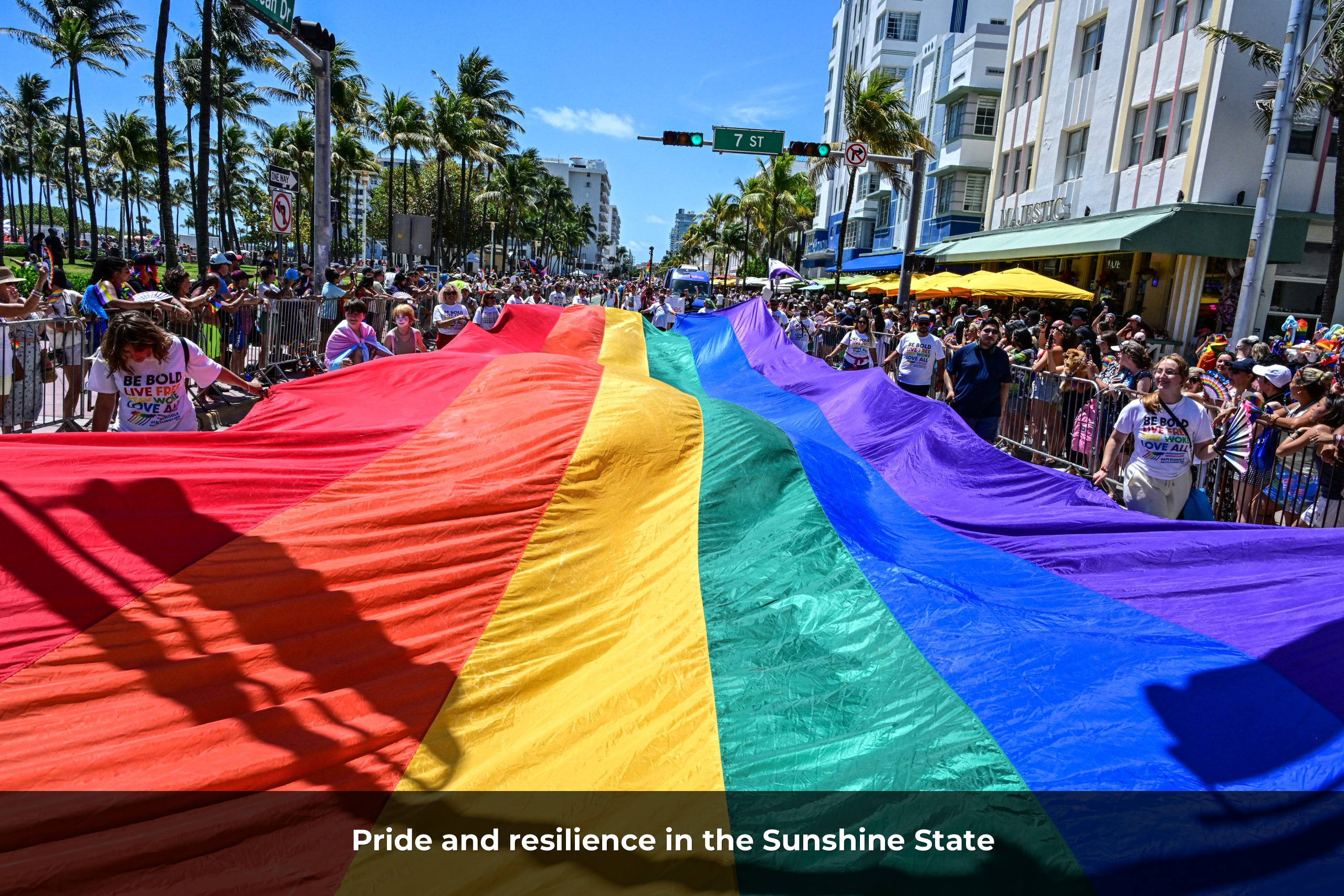

Florida has a magic that only Floridians truly understand. The mix of whimsy, bravery, and devotion you find here is unique, as is the land itself: lush acres of forest and marshy wetlands, puppy like creatures found in springs and slow-moving rivers, beaches of white sand, and off-the-beaten-path trails.
It’s tough to be from here—we’re plagued with hurricane season, mocked with GIFs like Bugs Bunny sawing from the rest of the country, and absurd “Florida man” jokes reflecting the tired 2010s-era cliché that our state is a den of drug-addled chaos and bizarre misadventure. If you mention Florida in conversation, you’re often met with a disgusted or concerning gaze.
The state has also long served as the country’s playground—or, as scholar Julio Capó Jr. describes it in his history of queer Miami culture, a “fairyland” that lures in tourists with the promise of a quick getaway surrounded by Disney animatronics and dreamy beaches. It may be unrecognizable to visitors from outside of the state, but Florida has always been a little queer, even beyond the periphery of the gay club scene in Miami.
In the past several years, however, Florida has become increasingly known for being hostile to queer people. Republican Governor Ron DeSantis—whose term began in 2019, less than three years after the June 2016 mass shooting at Orlando’s Pulse nightclub that killed forty-nine people—is fixated on decimating Florida’s queer population and crushing the morale of our indomitable spirit. In 2021, DeSantis signed into law a provision that redefined a public demonstration of more than three people who “commit a breach of the peace” as a “riot,” giving police officers leeway to enforce it against queer and trans protesters. The next year, DeSantis and the Republican-led state legislature passed a blitz of oppressive laws: the “Don’t Say Gay” bill, which restricted public school curriculum related to LGBTQ+ people and issues; the “Stop WOKE Act,” which restricted protected speech in the workplace related to systemic racism and sexism; and a ban on abortion after fifteen weeks. (This was replaced when a near-total abortion ban went into effect in 2024.) In 2023, DeSantis oversaw a rightwing takeover of the governing board at New College of Florida, resulting in seismic institutional and culture shifts at the Sarasota public liberal arts college.
Viewed as a gay utopia for queer and transgender youth, New College had been the obvious choice for Nya Jacobson. During Jacobson’s freshman year, DeSantis appointed a slate of conservative trustees at the school; within a year of the takeover, the gender studies department was eliminated, hundreds of library books were tossed in the dumpster, and students and faculty left New College in waves.
As a firsthand witness to this hostile takeover, Jacobson organized New College’s LGBTQ+ organization, Queery Club, even if it meant jeopardizing their future career. “I wasn’t sure of the implications, but I was like, ‘OK, I need to basically make a decision right now,’ ” they tell The Progressive. “ ‘I’m in my first year of college; I’ve got these big plans for my life and my future. Is this fight worth it?’ But I remember thinking, ‘I guess I’m gonna be a delinquent now.’ ”
Jacobson continues to see queer students enroll at New College, despite the incessant attacks on LGBTQ+ freedom. “Every time I see a new class of little baby gay freshmen,” Jacobson says, “I want to be able to show them that . . . they’re finally out of their parents’ homes; they can be who they want to be here, and they don’t have to be freaks for that.”
As this June marks the ten-year anniversary of the mass shooting that claimed forty-nine lives at the Pulse nightclub, queer Floridians have a grim and destabilizing decade to look back on. Our once-purple state has emerged as the nation’s petri dish for extreme rightwing legislation as an influx of wealthy conservatives into the state has weakened the voting power of those opposed to their government’s homophobic and transphobic agendas. In this climate, how do we stay afloat?
Floridians are desensitized to the violence of gun culture at a young age: friends’ parents owning guns, walking past a case of rifles at the big-box store near your school, seeing countless gun show billboards on Interstate 10. If you’re Black, you learn about guns at an even younger age than your white peers during conversations about Trayvon Martin, gun violence, and deadly encounters with the police. Reliable data is hard to come by—as so many guns are unregistered—but Florida is second only to Texas both in terms of the number of guns and the number of adults who report living in a home with guns. It means neighborhoods don’t feel safe. It makes it feel like gun violence could happen anywhere, like at the nightclub on a weekend. It’s inescapable.
On June 12, 2016, at one of Pulse’s weekly Latin Nights, Omar Mateen opened fire in the gay nightclub, resulting in what was then the deadliest mass shooting in U.S. history and is still the deadliest attack against LGBTQ+ people. Forty-nine people were killed and fifty-three were wounded. A majority of the victims were Latine, placing it within the culture of targeted violence faced by queer and transgender Latines in Florida.
The site of the former Pulse nightclub in Orlando, Florida, where forty-nine people were killed in June 2016 in the deadliest attack against LGBTQ+ people in U.S. history. In March 2026, the remnants of the nightclub were demolished, and a public memorial is expected to be finished in 2027.
In 2019, a group of survivors, family members of Pulse victims, activists, and scholars established the Community Coalition Against a Pulse Museum (CCAPM) to oppose the onePULSE Foundation’s $45 million plans to build a private museum. An open letter on CCAPM’s website reads, “We demand a tasteful and respectful public memorial to honor our loved ones where one can come to reflect, not a tourist attraction that charges admissions and sells mass shooting merchandise.” Additionally, the coalition seeks to hold the City of Orlando, the Orlando Police Department, and Pulse owner Barbara Poma accountable for the wide scope of unpermitted renovations and code violations at the nightclub, which further impeded the victims from escaping.
In 2023, the city of Orlando took over the memorial project, purchasing the property from Poma. In March 2026, the remnants of the nightclub were demolished. Orlando Mayor Buddy Dyer announced that the memorial is expected to be finished in 2027.
With Lux, a feminist magazine, I co-organized a multistate campus tour this past spring with stops at the University of Central Florida, Florida International University, and New College of Florida to encourage students to connect campus struggles to the larger political world. What my colleagues and I saw on this tour reflected my own experience as a student organizer at Florida A&M University (FAMU): Political action by college students is made a great deal stronger by support from off-campus community grassroots organizers.
Alongside student organizations, professors are grappling with the state’s war on education, including Evan Lauteria, an assistant instructional professor in sociology at the University of Florida. In March 2026, the state university system’s board of governors voted to remove Introduction to Sociology—deeming the course to be an alleged avenue for professors to promote leftwing ideologies and social justice advocacy—from the mandated core general education curriculum for freshman students.
“Less as a sociology professor and more as a Floridian, I think higher education is an avenue for young people to become engaged citizens, and so any attack on the education system is fundamentally an attack to democracy and an attack to civic engagement,” Lauteria tells The Progressive. “The attempts to eradicate history, to revise it, to prevent faculty from being able to talk about really well-established research on issues of stratification, inequality, or poverty, is fundamentally a threat to the whole citizenry and all of the people of Florida, and it should be treated as such.”
Lauteria ties the push to remove sociology to the Don’t Say Gay and Stop WOKE bills, and says that the goal of DeSantis’s administration is to “minimize the capacity of anyone to have critical thinking skills around these issues, which is why general education became their focus.”
While professors try to prevent the erasure of history and culture from their curricula, local organizers are also stepping up to the plate. The Walrus, a vegan restaurant in Jacksonville, dually serves as a third place for anarchist and Afrofuturist reading groups, drag shows, punk bands, and mutual aid drives. The owner, Alexander Eli, tells The Progressive that running a business as a trans person leads to security issues and tokenization, but their mission leads him to organize his rage and protect the “radical queer vegan bar that the city deserves.”
“People should have a place where they can wear a dress for the first time or be a part of nightlife culture in the South without feeling ostracized,” Eli says while drawing attention to the lack of nightlife catered to sapphic and femme-presenting people. By spotlighting queer joy as an act of resistance, dance parties—like Masisi Radio (Miami’s queer Caribbean collective) or Dyke Nite in Orlando—make space for underserved communities.
In the less than two years since it was founded, Dyke Nite has hosted a lesbian arm-wrestling party, craft nights, a “campy” strip spelling bee, and in April, a kiss-in rally on Lesbian Visibility Day, which included speakers from Central Florida Queers for Palestine and CCAPM. Alexia Clarke, one of the co-founders, says being in solidarity with strong grassroots movements in Florida is a necessity.
As Clarke recalls her college memories of clubbing at Pulse, which now feels like “a haunted house” on Orlando’s bustling Orange Avenue, she says that her unshakeable drive to create sapphic spaces led to Dyke Nite, because there is “power in numbers.”
Operating as the only queer and feminist bookstore in Tallahassee, Common Ground Books is decorated with kitsch, colorful stickers opposing the patriarchy, middle school graphic novels, and copies of Rachel Reid’s famed gay hockey romance Heated Rivalry. Although the best-selling Game Changers series is a hit, the top-selling category at Common Ground Books is nonfiction. “Perhaps it’s because of the demographics in Tally,” says Alex Spencer, the bookstore’s owner. College students at Florida State University and FAMU, as well as a strong presence of organizers and feminists in Tallahassee, make up a large share of the store’s customers. “A lot of people turn to books to further their education and fill in the gaps.”
Spencer, who opened the award-winning bookstore in 2022, recognizes that the influx of customers is not just because of the store’s proximity to the state Capitol and universities. Common Ground Books attracts queer elders, curious young readers, and those craving a third place where locals can explore their gender with binders or a new wardrobe of clothes, accessories, and makeup. Aside from the literature, the store offers free contraceptives, Narcan, bilingual informational cards about Constitutional rights, nonperishable goods, and hygiene products—plus you can always find a flyer for an upcoming rally or craft night.
Spencer had to cease the bookstore’s “Drag Story Hour” due to threats from counter-protesters and the political fallout from Florida’s vague “Protection of Children” act, the 2023 law which sought to prohibit children from attending any “adult live performance” that features sexual or lewd conduct. She insists, however, that the community of drag queens, transgender people, and grassroots organizers offer enough support to sustain business.
Tallahassee’s fluctuating yet tight-knit environment as a college town has built a ragtag group of working-class avengers: union workers, guerilla gardeners, abortion advocates, climate activists, college students, and librarians.
Delilah Pierre, the president of the Tallahassee Community Action Committee, has a highly regarded presence in Tallahassee’s activism circles for leading rallies against racial and trans injustices and creating the now-defunct citizen’s police review board. Citing Tallahassee’s civil rights-era bus boycott in 1956 led by the Reverend Charles Kenzie Steele, and sisters Patricia and Priscilla Stephens, who organized the Congress of Racial Equality’s sit-in with other FAMU students in 1960, she credits former Tallahassee residents for laying the groundwork to create a legacy of Black activism.
“They put conscious attention into making sure that when they leave—and many of them will leave—don’t just leave everyone else to pick up the pieces,” Pierre tells The Progressive. “We have a plan for what leaving and transitional leadership is going to look like and what it means for someone else to be in a leadership role.”
Although college campuses have been a decades-long route for radical ideologies through student-led feminist, identity-based, and LGBTQ+ organizations, being a born-and-raised Floridian offers a unique introduction to political consciousness. Without the academic language to understand how these historic events affect everyday people—not to mention the actions that remove words like “culture” and “diversity” in textbooks—how does one voice their interest in political education?
Dara Britton, a homeschooled student in Leon County, says that her identity as a queer mixed-race person of Jamaican descent is one of many things that motivated her to participate in direct action, including a protest against U.S. Immigration and Customs Enforcement assembled by a high school student in Leon County and Tallahassee’s No Kings rally in March.
“I’m involved with a lot of homeschoolers and homeschool communities that are very queer and very open about their identities,” Britton, who uses she/they pronouns, tells The Progressive. “We build more surface-level connections about our common interests, and there’s so many people who are not scared to be themselves and their own identities.”
Their closest friends, whom they met through a self-described homeschooling co-op, bond over their shared fear of book bans and attend protests together. “That’s what really brings us together—knowing that we are each other’s safe spaces and that we always have each other to turn to. It’s something that I haven’t really had before I joined this co-op.”
At seventeen years old, Britton says she just “hopes to bring some joy.” Her resilience speaks for itself. “To the people who are feeling hopeless in this situation, look to other people. It’s easy to get wrapped up in [the news cycle] online, but you can’t help anyone if you’re not helping yourself. Turn to your friends, family, and the people who know how to help you. Spread the awareness and kindness that we want to get and hope to bring to the world. We are a community, even if some people don’t want us to be.”
Despite the obstacles, LGBTQ+ creators and activists with resounding connections to Florida are reimagining a queer utopic version of the state. One that cares about its at-risk citrus trees, doesn’t build prisons over wetlands, prioritizes citizen-led committees instead of creating police training facilities, and supports queer authors rather than banning their books. Recent documentaries display an orange-tinted lens on Florida’s political struggles, such as Sasha Wortzel’s River of Grass, a psychedelic reimagined namesake of Marjory Stoneman Douglas’s book, and Patrick Bresnan’s First They Came for My College, which follows DeSantis’s coup at New College of Florida.
Can’t Stop Change: Queer Climate Stories from the Florida Frontlines is another among these projects. The feature-length documentary chronicles climate justice through the eyes of fifteen artists, educators, and organizers. To open the film, Miami-based organizer Valencia Gunder speaks directly to some of the most marginalized Floridians: “Queer people, trans people, migrant people, Black people, brown people—this is your Florida. Don’t you let nobody tell you you need to go back where you came from.” She continues, applauding Floridians for their self-determination—an undeniable trait embedded in the DNA of most residents, allowing them to endure hurricanes and envision a liberated version of Florida.
V Starks, an associate producer who is also featured in the film, understands this self-determination well as a born-and-raised Floridian from Jacksonville, the Southeast’s largest city. After attending a screening of Can’t Stop Change, Starks’s interest was piqued by seeing queer Floridians depicted in a way that didn’t write off the state as the nation’s armpit. Starks—who considers his high school’s Genders & Sexualities Alliance, natural hair club, and feminist club as their entry into radical thought and grassroots organizing—credits their role in the film as a challenge to rethink how he thought about his hometown.
“I have so much love and respect for people who are there, and my heart is there, but I have geographically, physically separated myself,” Starks says of Jacksonville and his decision to temporarily move to Atlanta, Georgia, during the COVID-19 pandemic.
Thanks to Starks’s involvement, Jacksonville was included in the extended cut of the documentary, introducing characters like Paige Mahogany Parks, the vibrant founder of the Transgender Awareness Project, who publicly condemned the uptick of Black transgender women murdered in Jacksonville in 2018.
Above all, Starks hopes the film encourages people to interrogate queerness alongside the ways that we shape and shift narratives and affect change within our communities. “The film has been so core to my expanded understanding of abolitionist possibility,” he says. “If we can question gender—something that’s taught so neatly and ingrained—we can question anything. We can deconstruct and destroy worlds and build worlds.”
Collective action is the contingency plan that gets us through hurricanes, book bans, and riot bills. Attending drag shows and protests with our neighbors expands our unlimited endurance in our fight for a state that sees and accepts us for who we are. Through the work of countless LGBTQ+ and youth organizers, we can see that Florida is worth fighting for.
