Tag: This

  • ‘A pathetic power grab’: Trump purges bipartisan election assistance commission

    ‘A pathetic power grab’: Trump purges bipartisan election assistance commission

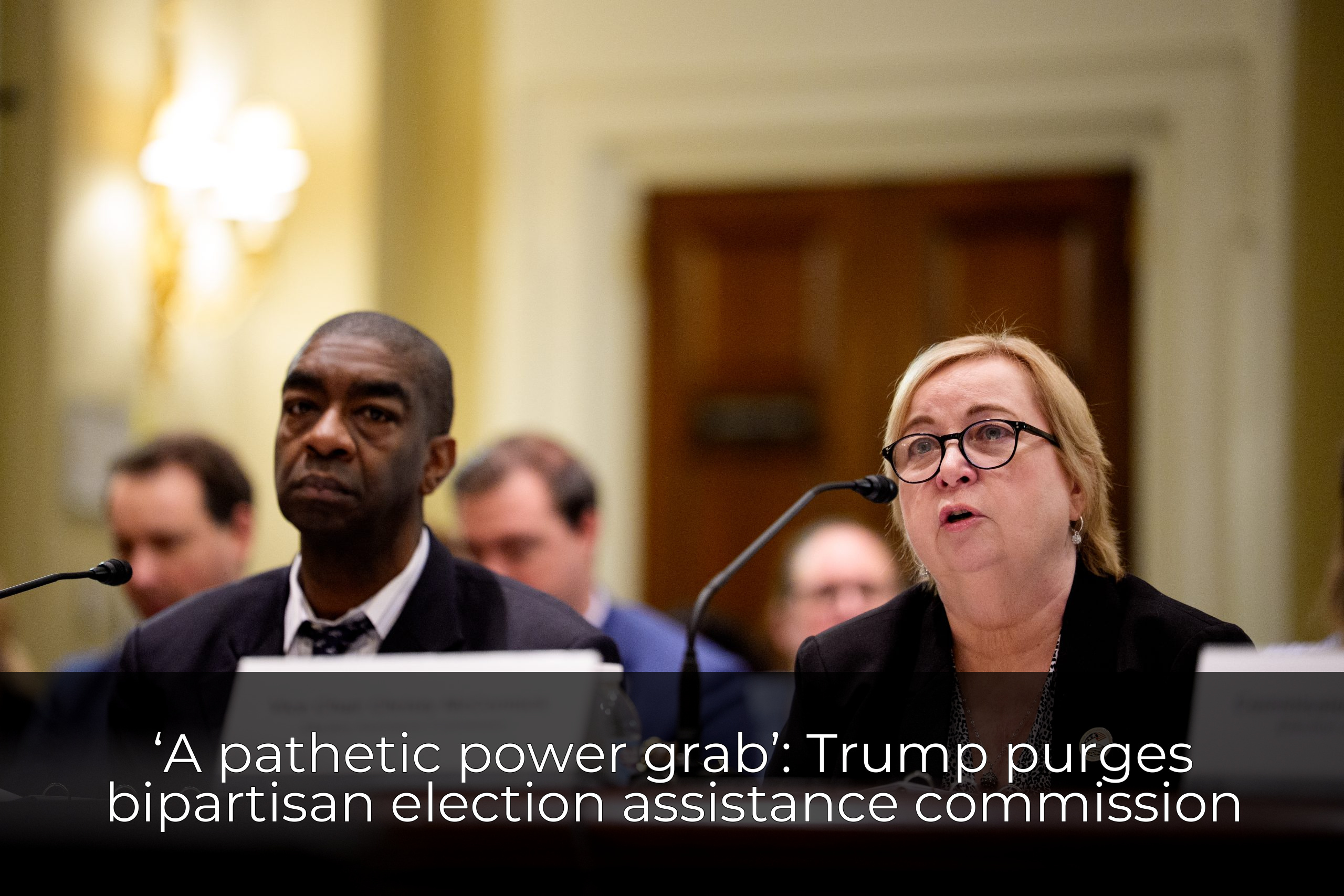
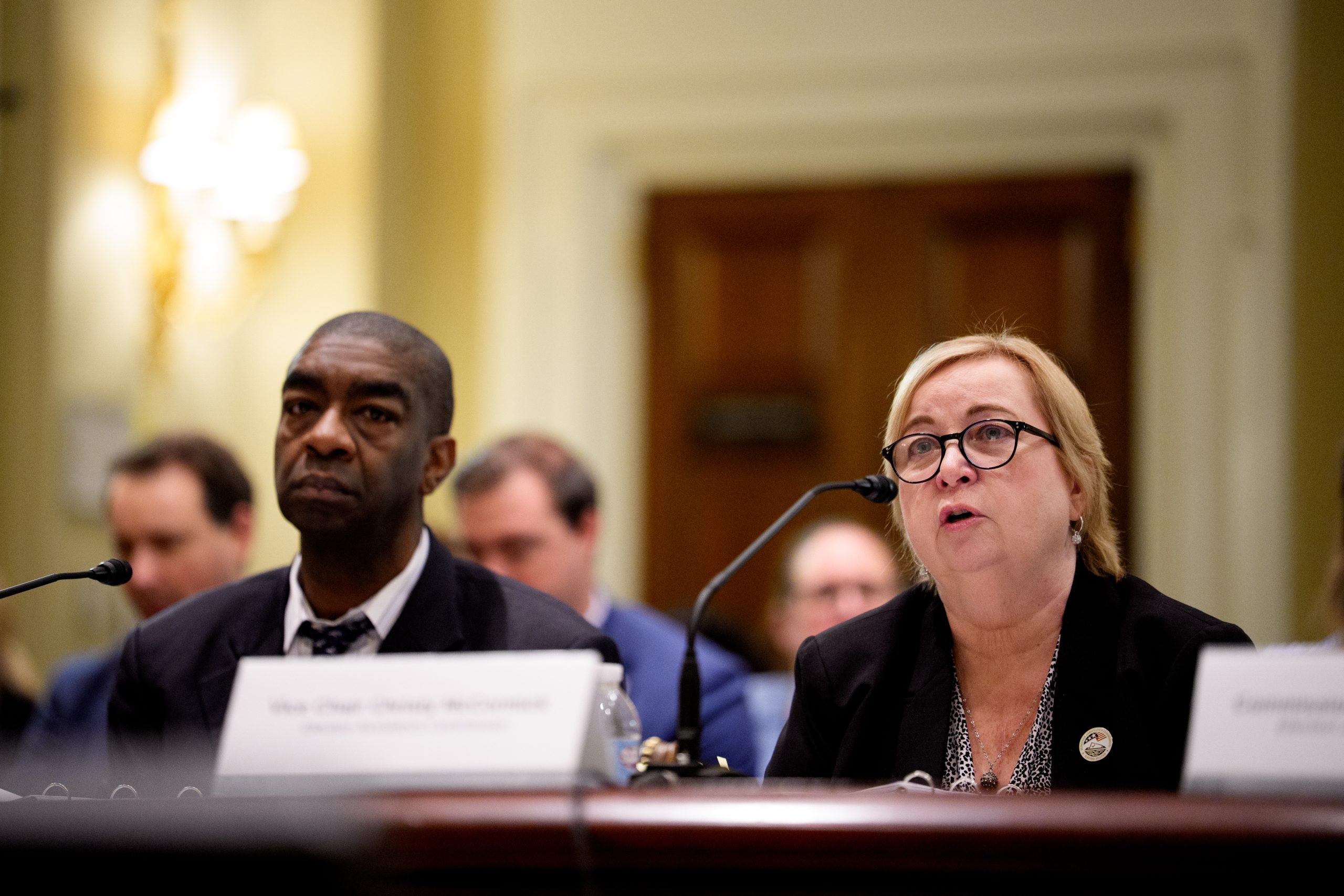
    U.S. Election Assistance Commission Vice Chair Christy McCormick (R), accompanied by U.S. Election Assistance Commission Chairman Thomas Hicks (L), speaks during a House Administration Subcommittee on Elections hearing on Capitol Hill on May 20, 2026 in Washington, DC. Photo by Andrew Harnik/Getty Images
    Common Dreams Logo

    This story originally appeared in Common Dreams on July 10, 2026. It is shared here under a Creative Commons (CC BY-NC-ND 3.0) license.

    US President Donald Trump late Thursday forced out the remaining three members of an independent, bipartisan commission that assists state election officials across the country, a move that critics condemned as a “pathetic power grab” ahead of the 2026 midterms.

    The two Democratic members of the Election Assistance Commission (EAC), Benjamin Hovland and Thomas Hicks, were fired, and Republican Commissioner Christy McCormick resigned at the White House’s request, according to ProPublica. The agency, established by Congress more than two decades ago, now lacks leadership and any ability to make decisions, just months before the 2026 elections.

    The EAC, as its website states, is “an independent, bipartisan commission whose mission is to help election officials improve the administration of elections and help Americans participate in the voting process.” In an executive order last year, Trump ordered the EAC to implement proof-of-citizenship requirements in the federal voter registration process, along with other changes. The president’s effort to impose his policy demands on the EAC was mostly blocked in federal court.

    Trump, who has said he wants his administration to “take over” voting nationwide ahead of the 2026 midterms, has since taken other steps that watchdogs and Democratic lawmakers say amount to an attempt to preemptively subvert the coming elections, including a sweeping assault on mail-in voting—which is also facing legal challenges. Legislatively, Trump is pushing Republicans to pass the SAVE America Act, a bill that experts say would prevent millions of Americans from voting.

    Michael Waldman, president and CEO of the Brennan Center for Justice, said Thursday’s EAC firings “are deeply concerning in light of President Trump’s relentless efforts to try to interfere in elections.”

    “These removals leave the agency without leadership and unable to carry out its major responsibilities,” said Waldman. “The guardrails Congress placed on this agency are clear and must be followed: The Election Assistance Commission was designed to be bipartisan with four members, no more than two of which can be from the same political party. The agency cannot make any significant decisions or take any significant actions unless three confirmed commissioners agree. Until bipartisan replacements are confirmed, the agency cannot lawfully make any decisions that affect how Americans vote.”

    Lisa Gilbert, co-president of Public Citizen, said Trump’s termination of EAC commissioners underscores that “he’s scared of the voting power of the American people.”

    “This move is another pathetic attempt to sow doubt in our elections, which are safely and expertly run by states and localities,” said Gilbert. “This agency deserves a steady hand and expert leadership. That said, it is important for voters to know that states and localities, not the EAC, run our elections. Even more importantly, it is the voters who decide who takes office.”

    The EAC firings came less than two weeks after the conservative-dominated US Supreme Court handed Trump the power to purge independent agencies at will with its Trump v. Slaughter ruling, erasing around 90 years of precedent.

    Election law expert Rick Hasen warned in a blog post on Thursday that Trump “could try to direct the commissioner-less EAC to do his bidding, for example by stating that the EAC must amend the federal voter registration form that states must accept for federal elections to include documentary proof of citizenship.”

    “Trump’s first voting-related EO tried to do this, and he was stymied. But that was acting through the commissioners and before the Slaughter case,” Hasen noted. “If he tries anything like this, it will be high-profile and very important litigation that will end up at the Supreme Court on the emergency docket over the summer.”

    Adrian Fontes, Arizona’s Democratic secretary of state, said in a statement late Thursday that the EAC purge was “irresponsible and dangerous,” accusing the administration of remaining “dead set on causing chaos for our election officials across this country.”

    “This move undermines the integrity of nonpartisan election administration,” Fontes added.

  • Israel is murdering Dr. Hussam Abu Safiya. The US media is covering up the crime.

    Israel is murdering Dr. Hussam Abu Safiya. The US media is covering up the crime.

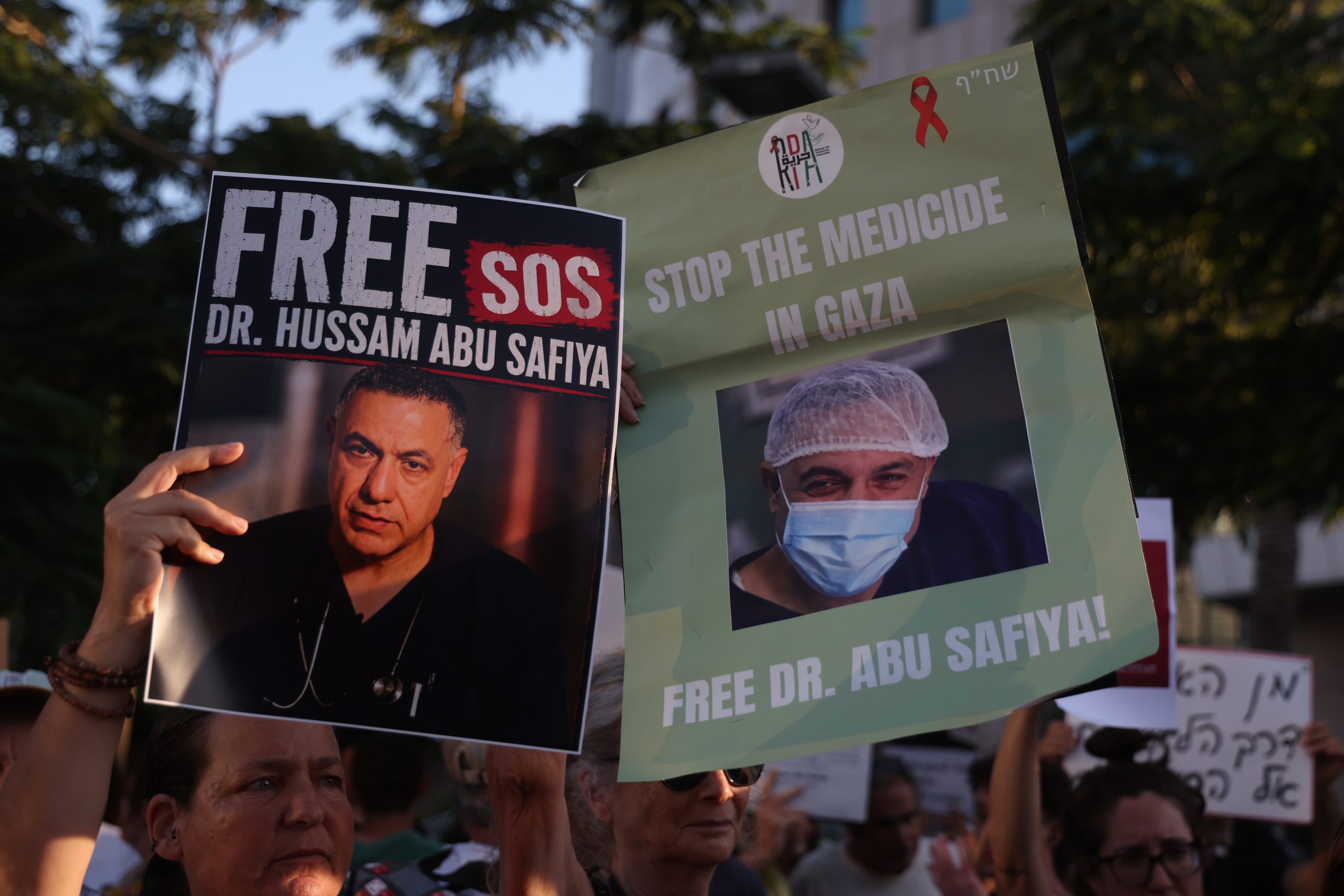
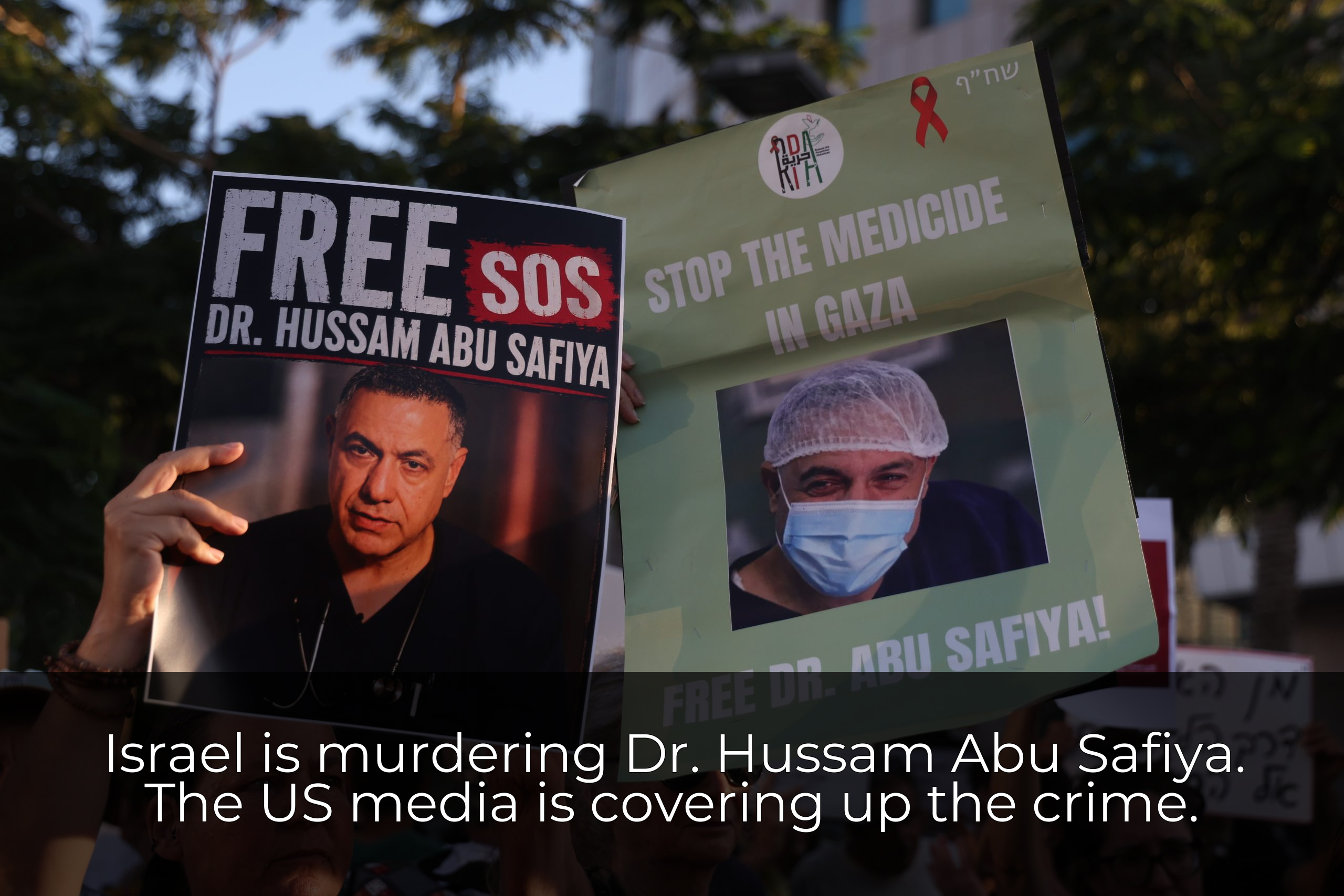
    Activists gather to stage a protest demanding the release of Dr. Hussam Abu Safiya, director of Kamal Adwan Hospital, in Tel Aviv, Israel on July 06, 2026. Photo by Saeed Qaq/Anadolu via Getty Images

    This story originally appeared in Mondoweiss on July 08, 2026. It is shared here with permission.

    By now, editors at the New York Times and producers at CNN are surely squirming over what to do about Dr. Hussam Abu Safiya, the Gazan doctor and hospital director who Israel has locked up for a year and a half without trial, and who says his jailers are trying to kill him.

    Worldwide campaigns, by Amnesty International and other human rights groups, have called for Dr. Abu Safiya’s release and global media coverage has been significant. Britain’s flagship newspaper, the Guardian, has naturally already reported about Dr. Abu Safiya. Here is its July 6 headline: “Detained Gaza doctor almost unrecognisable after injuries in Israel jail, lawyer says.” Even the Israeli press have reported about him, including covering a demonstration in Tel Aviv on July 6 drawing attention to his case.

    But in the American media, there has been a complete blackout about his case and his dire condition.

    As of July 7, the New York Times has not mentioned his name a single time since January 2025. The Washington Post did run an Associated Press report, but there was no fanfare on the Post home page and you had to search hard for the article. In the Wall Street Journal so far: nothing. CNN’s website did have a short video report, but it apparently never appeared on the network’s U.S. outlet. Dr. Abu Safiya is also missing on MS Now, supposedly the most progressive cable network.

    As this site and other alternative media have regularly reported, Dr. Abu Safiya, a pediatrician who was the administrator of the  Kamal Adwan hospital in Gaza, turned himself in to the Israeli army on December 27, 2024. There is an iconic photo of him, in his white physician’s coat, walking through the rubble in Gaza toward an Israeli tank. (Somehow that photo has never made it into the New York Times.) Since then, first-hand accounts from his lawyer and now his son have alerted the world about his terrible treatment in various Israeli jails and his physical deterioration. Dr. Abu Safiya, now held in Rekefet Prison, has said: “They’ve brought me here to kill me. I don’t see myself surviving. This is the end.”

    Israelis have insinuated that Dr. Abu Safiya is somehow linked to Hamas, but he has never been charged with any crimes. But the media is not supposed to decide on his guilt or innocence before reporting on his jailing. Hiding the story of Hussam Abu Safiya is clearly pro-Israel censorship, and unfortunately all too characteristic of America’s newspapers and cable networks in their coverage of Palestine.

    What’s more, the U.S. media is also covering up a much bigger story. Dr. Abu Safiya is being held without trial, in what Israel euphemistically sometimes calls “administrative detention.” Precise figures are hard to confirm, but Amnesty International has estimated that at the end of 2025 Israel was holding 4,622 Palestinians, from both Gaza and the occupied West Bank Palestine, without putting them on trial. 

    Dr. Abu Safiya’s terrible situation, which even just by itself is newsworthy, could also serve as a news peg to write about Israel’s administrative detention policy. National Public Radio, to its credit, did just that back on May 30. Its excellent on-air report even interviewed Dr. Abu Safiya’s son, Ilyas. 

    Mainstream media reporters based in Israel who want more background could drop into the offices of Israel’s premier human rights organization, B’Tselem, which monitors the detentions, even though Israel’s government no longer gives them the figures. Here’s one of their reports.

    What’s extraordinary about the U.S. self-censorship is that the Israeli media has reported about Dr. Abu Safiya’s plight. Haaretz, Israel’s newspaper of record, even ran an editorial charging the Netanyahu government with mistreating him and others, and urged Israeli courts to “halt the ongoing starvation, abuse and imprisonment.” And even the more right-wing Times of Israel has at least recognized his existence.

    What explains the cowardice at the New York Times and at CNN? Even those of us who have spent years monitoring the distorted and dishonest U.S. coverage are stupefied. 

    (more…)

  • In a divided country, U.S. residents agree on one thing: no data centers 

    In a divided country, U.S. residents agree on one thing: no data centers 

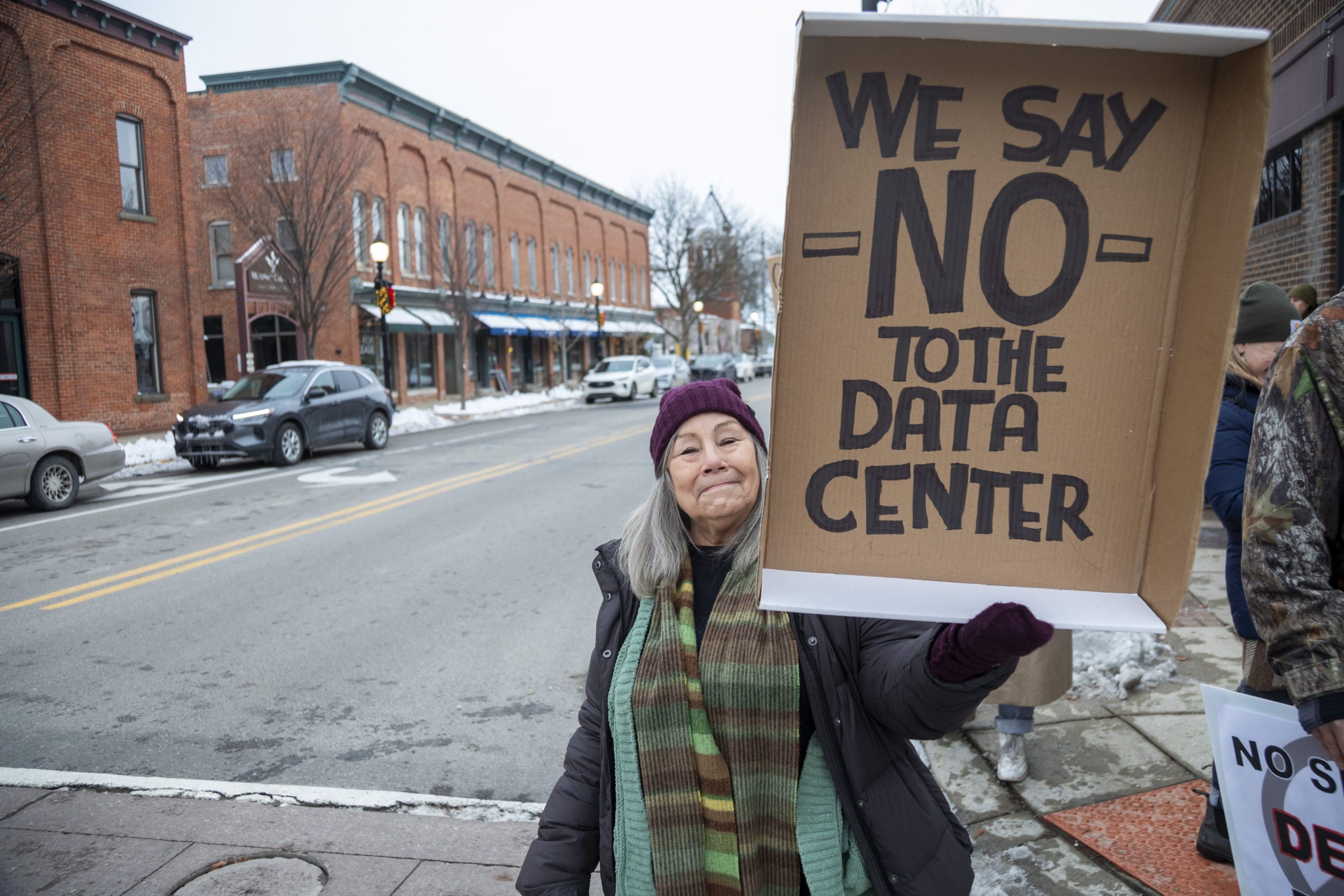
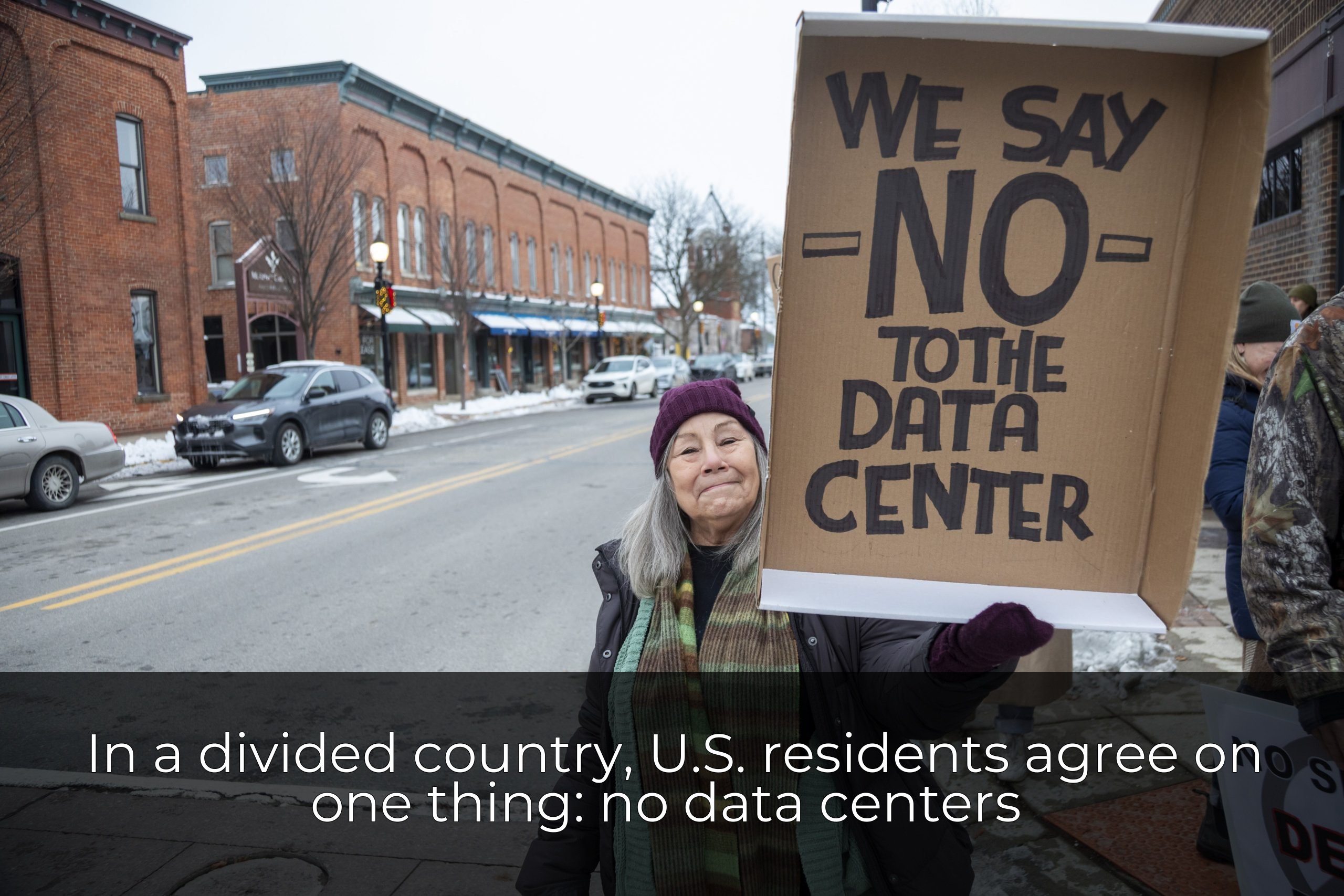
    Rural Michigan residents rally against the $7 billion Stargate data center planned on southeast Michigan farm land. Photo by: Jim West/UCG/Universal Images Group via Getty Images

    This story originally appeared in Prism on June 29, 2026.

    Across the country, politicians are starting to heed the public’s concerns about data centers. 

    Almost 75% of Americans across the political spectrum oppose constructing data centers near their homes, according to a recent Gallup poll. A majority—63%—are concerned by federal regulatory agencies’ practice of approving projects without first evaluating environmental and public health concerns. 

    These numbers not only paint a stark picture of the massive backlash to the rapid and rapacious buildout of data processing facilities (some of which consume enough energy to power a midsize city), but they’re also an indicator that the public feels very differently than the corporations pushing for their construction. The country has never been more divided, but on data centers, residents agree: It’s time to pump the brakes. 

    Communities that are already forced to contend with the consequences of data centers warn of their near-constant noise pollution, voracious consumption of water, and discharge of pollutants into local ecosystems. However, it’s not just environmental concerns that undergird the community-led protests against data center development. Many are also concerned about how data centers come to fruition—often through violations of democratic processes in the form of shadowy backroom deals and nondisclosure agreements. There’s also the continued rise in utility rates at a time when nearly half (49%) of American households don’t make enough money to cover expenses. Americans contend with issues of drought, fossil fuel dependence, and habitat loss. Generational farmland is being gobbled up to prop up acres of data warehouses. The list goes on. 

    Three years after OpenAI’s artificial intelligence (AI) tool Chat GPT forever changed the world’s orientation to computing, governments are responding to community needs for more information by implementing temporary moratoria on the construction of potentially harmful facilities. 

    “I would say this is the fastest I’ve ever seen [the legislature] move,” Pricey Harrison, a North Carolina state representative, said about her state’s approach to data-center regulation. “The reaction has been, I think, fast enough to do something about it. Thirty North Carolina municipalities—and counting—have considered or approved data center regulations and moratoria. 

    Where do other moratoria stand? Here’s what to know.

    States catching up with local government 

    Fourteen states have either introduced, passed, or rejected data center moratoria legislation, according to the National Conference of State Legislatures. A bill introduced in South Dakota would prevent new construction or expansion of hyperscale data centers for one year. Another in Oklahoma would pause data center construction until November 2029 to allow the legislative body to study impacts. Pennsylvania’s legislature is currently considering a three-year moratorium on new hyperscale centers. 

    Harrison introduced North Carolina’s legislation on a moratorium, though it didn’t get traction. “My hope was that it was about putting a stop to them until we had the guardrails in place,” Harrison said.

    No moratorium has been signed into law at the state level, though one in New York, which would halt data center construction for three years, is sitting on the governor’s desk. Another in Maine was vetoed by Democratic Gov. Janet Mills in April. 

    In March, Sen. Bernie Sanders and U.S. Rep. Alexandria Ocasio-Cortez, introduced federal legislation aimed at curbing the supercharged expansion of data centers, which the officials argue are a threat to millions of jobs and planetary health. Last year, Sanders presented a report to the Senate Committee on Health, Education, Labor and Pensions that artificial intelligence and automation could replace nearly 100 million jobs in the U.S. over the next decade. For perspective, there are approximately 170 million employed people in the country, per the Bureau of Labor Statistics. 

    The greatest success in passing moratoria has been found at the local level. 

    The benefit of a moratorium  

    A moratorium on data center construction and expansion is not a ban. An outright ban has only been achieved in one place in the country: Monterey Park, California. In the June election, 86.3% of voters approved a ban on data centers. “We hope that other communities will use the model set by residents here in Monterey Park as inspiration to stop datacenters from encroaching in their backyard,” Monterey Park city councilmember Jose Sanchez told The Guardian.

    As Prism previously reported, corporations benefit enormously when they can build data centers as quickly as possible because it diminishes the risk of public pushback. Companies lobby for environmental agencies to reduce the regulatory review process for construction of destructive facilities, support state legislation that hampers a local government’s ability to implement cautionary legislation, and prevent public officials from discussing ongoing negotiations for permits. By the time the public finds out about a planned facility, cement is already in the ground.

    Mitch Jones, managing director of policy and litigation at the government accountability organization Food & Water Watch, told Prism that what’s needed is more information. Construction and operations of data centers have been a black box, and residents need to know what’s happening to their local resources in order to protect themselves. 

    “The stronger moratoria are the ones that, one, last longer and thus give time; and two, require real detailed studies of the various impacts that data centers have in communities and states,” Jones said. “We don’t believe that these studies can be hurried, or we’re going to get the policy wrong.” 

    Pushing back against industry talking points

    After Mills, Maine’s governor, vetoed the country’s first bipartisan bill on a data center moratorium to favor the construction of a data center in the town of Jay, the company behind the facility pulled out, and cities got to work passing their own moratoria. 

    Bill Pluecker, a local representative in Maine, told Prism that in May, his town of Warren proposed its own moratorium in response to Mills’ veto. A special town meeting is now scheduled for July 8 to determine whether to enact the moratorium. 

    “I think she wasn’t nuanced or wasn’t looking at the way that AI and data center development is different than a Walmart going in, or different from what we all really want in Maine,” Pluecker said.

    According to Pluecker, this moment of data-center expansion requires more political discernment and a shift in approach to economic stimuli. “Development in any form is preferable over regulation” is the kind of perspective that “holds us back,” Pluecker added, noting that if Mills’ reaction to data centers was any indication, representatives can be easily swayed by the promise of jobs—even when there are no long-term jobs to be found. 

    According to Food & Water Watch research, one permanent job in the data center industry costs $13 million of investment. In Virginia, which has become ground zero for data center development, a non-data-center job requires an investment of about $137,000. Based on employment records, Food & Water Watch estimated that despite being the hub of data centers in the U.S., fewer than 8,000 people were permanently employed in Virginia data centers. Nationally, there are as few as 23,000 people employed in data centers, according to Jones. 

    As for moving forward, Harrison is hopeful that voters on either side of the aisle can come together in her usually Republican, industry-friendly state. “I feel very confident that there is bipartisan, widespread support in North Carolina to do something about data centers,” Harrison said. “People are concerned and legislators are hearing from their constituents all over, rural [and] urban. I’m encouraged about potential movements.”

    Editorial Team:
    Tina Vasquez, Lead Editor
    Sahar Fatima, Top Editor
    Stephanie Harris, Copy Editor

    (more…)

  • US Media doesn’t think Palestine ‘has a right to exist’

    US Media doesn’t think Palestine ‘has a right to exist’

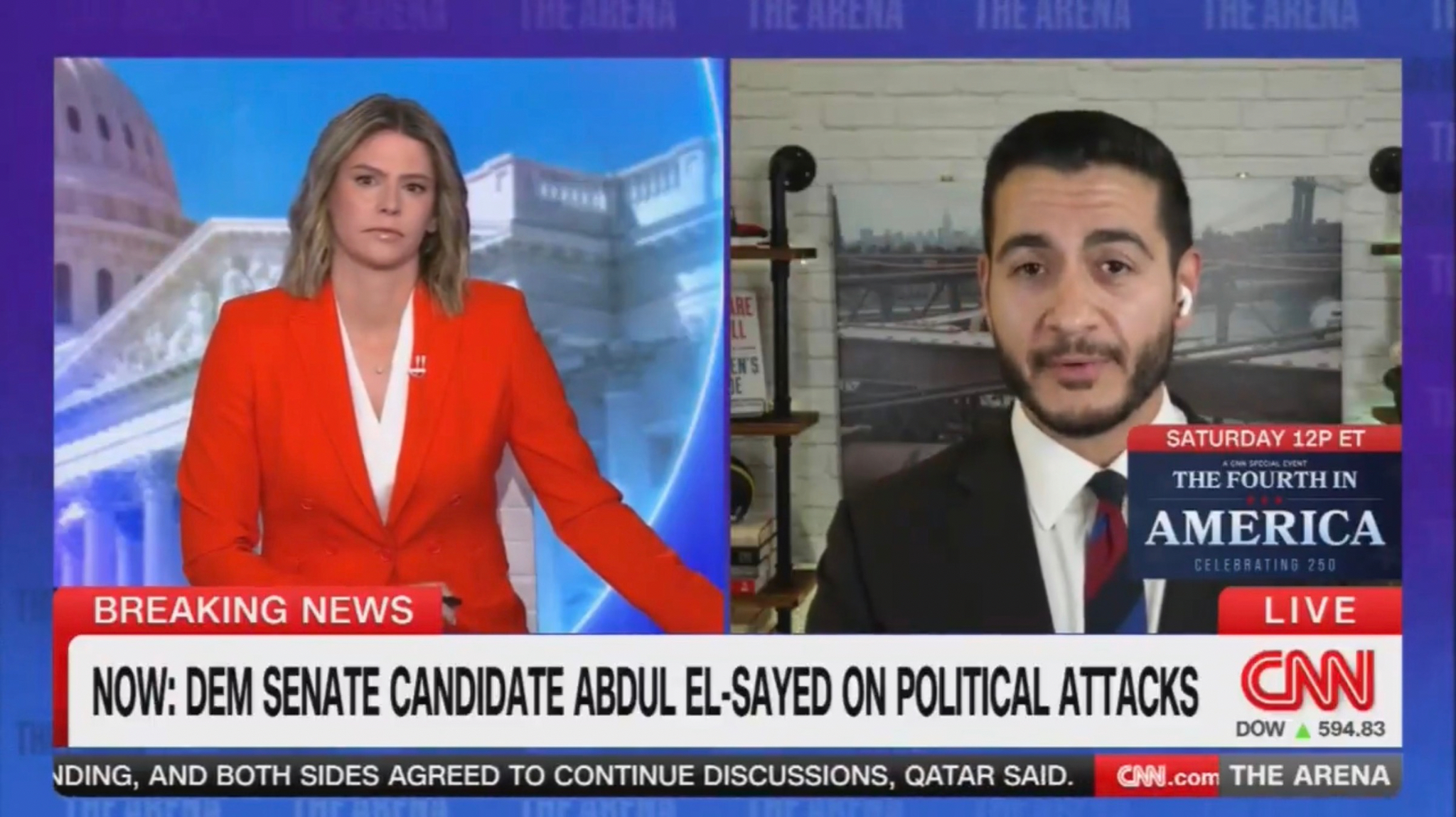
    Senate Candidate Abdul El-Sayed is asked by CNN anchor Kasie Hunt if Israel has ‘a right to exist.’ Screenshot/CNN

    While he was being grilled by CNN over his positions on Israel this past Thursday, candidate for the Democratic nomination for Michigan’s Senate seat, Abdul El-Sayed, was asked the bog-standard cable news question for anyone not on program with the pro-Israel Washington consensus—Do you think Israel has a right to exist?—three different times. It’s a ritual so routine one could hardly notice the exchange, but there was something in El-Sayed’s reply that exposed how facile this line of questioning is and that is worth examining in its own right. He responded, in part, by noting that “nobody has ever asked [him] if [he] thinks Palestine has a right to exist.” Watch the full exchange below.

    It was a throw-away line before he moved on to his long, fairly pointed, reply, but it’s an essential point, and worth making. And it is an empirical question one can survey and analyze. So, does US media ever ask politicians if they think Palestine has a right to exist? The answer: never. 

    A survey of the New York Times, Washington Post, Wall Street Journal, Politico, USA Today, Fox News, MSNBC/MSNOW, and CNN over the past 10 years shows that not a single candidate for office has ever been asked by a cable news anchor or reporter if “Palestine has a right to exist,” nor has their position on Palestine’s “right to exist” ever been interrogated or examined in print media. Indeed, the phrases “Palestine has a right to exist” and “Palestine’s right to exist” have only been written in or spoken on New York Times, Washington Post, Wall Street Journal, Politico, USA Today, Fox News, MSNBC/MSNOW, and CNN a total of six times over the past 10 years: 3 on MSNBC/MSNOW (one mention brought up in the context of EU powers recognizing Palestine last year, and two brought up by guests), once on CNN (brought up by Palestinian-Canadian guest Diana Buttu in 2018), and once each in USA Today and the New York Times when they quoted the Prime Minister of Spain Pedro Sánchez upon his recognition of a Palestine state earlier this year. 

    In other words: Palestine’s “right to exist” has not, in the past 10 years, been brought up as a question to a guest, politician, or candidate on cable news, nor has it ever been a point of journalistic interrogation or discovery. It has been a total non-issue.

    By contrast, the phrases “Israel’s right to exist” and “Israel has a right to exist” have been used in the above outlets 1,001 times, 334 times more often, in the same 10-year timeframe. The New York Times has evoked Israel’s “right to exist” 189 times, Washington Post 119, the Wall Street Journal 59, Politico 121, USA Today 65, MSNBC/MSNOW 106, CNN 144, and Fox News 198 times. If we remove Fox News as a standard deviation (many, of course, don’t consider Fox News a legitimate news organization), then the total is 803 versus 6, or 133 times more than its been brought up for Palestinians. The data and links to the findings can be found here

    Candidates are asked if they support “Israel’s right to exist.” Politicians affirm it, often unsolicited, as a matter of ritual. And refusing to do so is turned into a multi-day media-curated scandal.

    The affirmation and centering of this supposed ‘right’ for Israel is a central driver of major outlets’ coverage of politicians and candidates’ positions on Israel. Candidates are asked if they support “Israel’s right to exist.” Politicians affirm it, often unsolicited, as a matter of ritual. And refusing to do so is turned into a multi-day media-curated scandal, as evidenced by CNN following up El-Sayed’s refusal to play their gotcha game by questioning his supporter, Rep. Ro Khanna, over the issue. Khanna was asked by CNN’s Dana Bash the very next day if he believed Israel has a “right to exist” as an ethno-supremacist state. A framework Khanna dutifully affirmed, claiming––paradoxically––he supported Israel as a “Jewish state” and as a “state with equal rights” without spelling out how that would be remotely possible:

    El-Sayed’s refusal to affirm the premise that Israel has a “right to exist” is the type of response that wasn’t just scandalized in the moment, it requires follow-up interrogation of one’s political allies the very next day, and presumably more follow-ups after that as the primary in Michigan reaches its home stretch. 

    Bash, and CNN more broadly, have, of course, interviewed dozens of politicians, both American and Israeli, who explicitly refuse to recognize Palestine either in principle or as an existing state. This includes Prime Minister Benjamin Netanyahu, who, based on this survey, despite explicitly opposing the creation of a Palestinian state, has never once been asked if he believes Palestine “has a right to exist.” Explicit Islamophobes, anti-Arab racists, and anti-Palestinian bigots in Congress like Reps. Randy Fine, Nancy Mace and Brandon Gill––who not only reject the idea that Palestinians even exist, but openly traffic in overt religious and racist hatred––are never asked by CNN if they think Palestine has a “right to exist,” and they and their colleagues are certainly not grilled about it over several days. It’s simply a nonissue. Dehumanizing and belittling Palestinians and their right to live freely in their land is taken for granted in US media as a normal and uncontroversial opinion.  

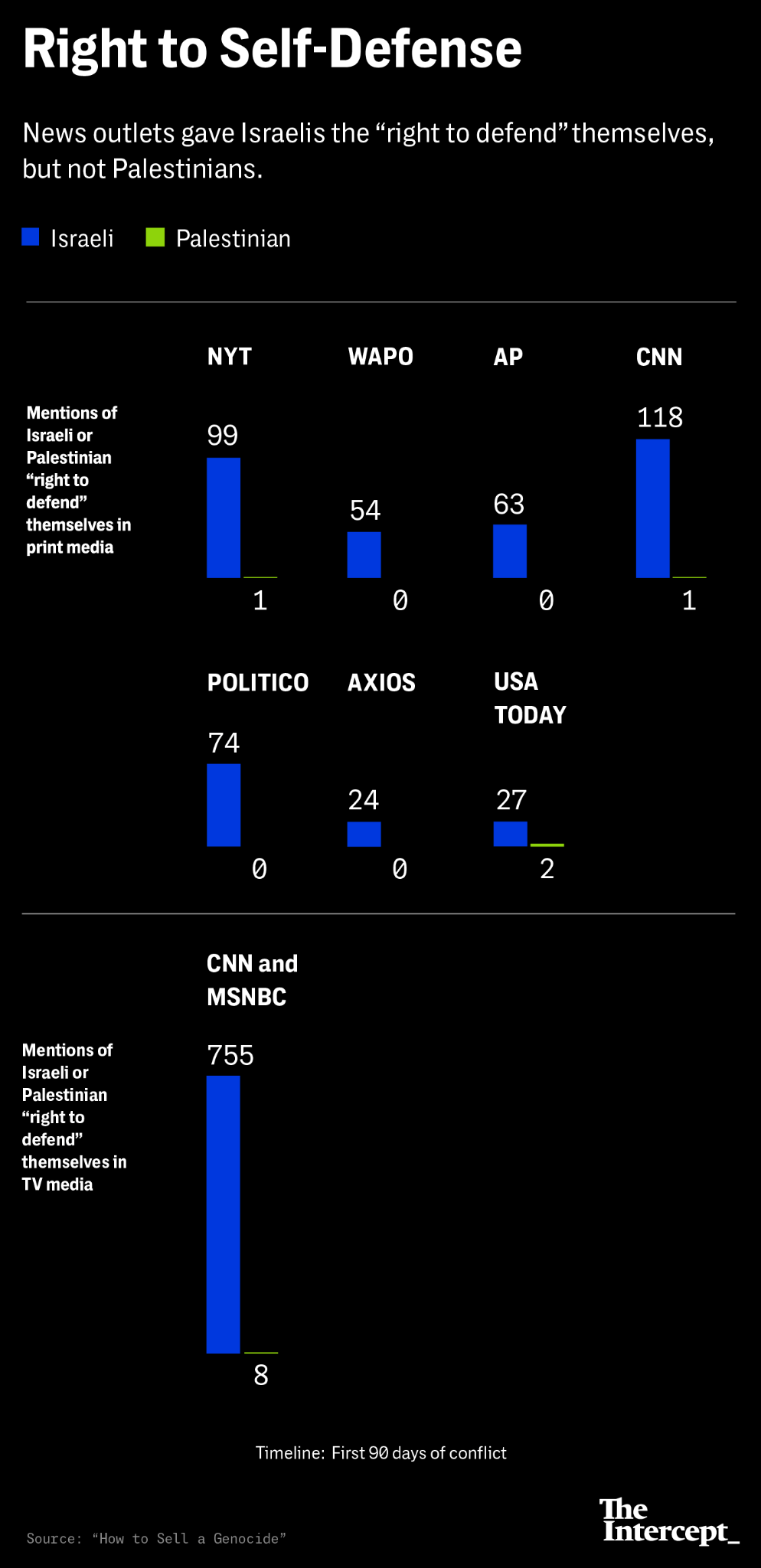
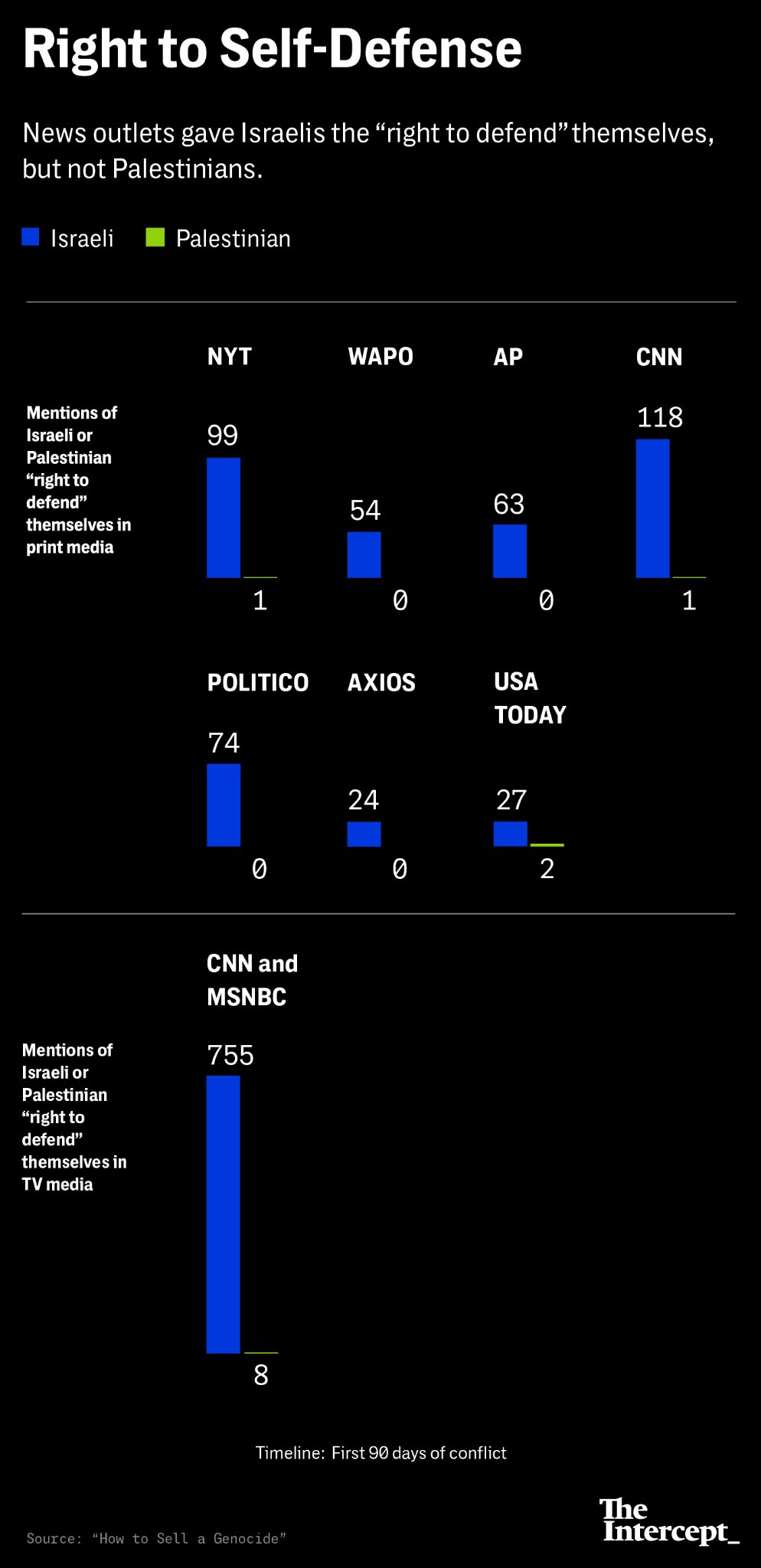
    The corollary right to a “right to exist” is the “right to defense” or “to defend oneself.” This right, abstracted out into a seemingly banal truism, is evoked almost exclusively for Israelis. As I wrote in the Intercept, In my new book How To Sell A Genocide, I detail how this ‘right’ is almost entirely reserved for Israel, as it was afforded this right over 100 times more frequently than Palestinians in print media and cable news. (image via The Intercept

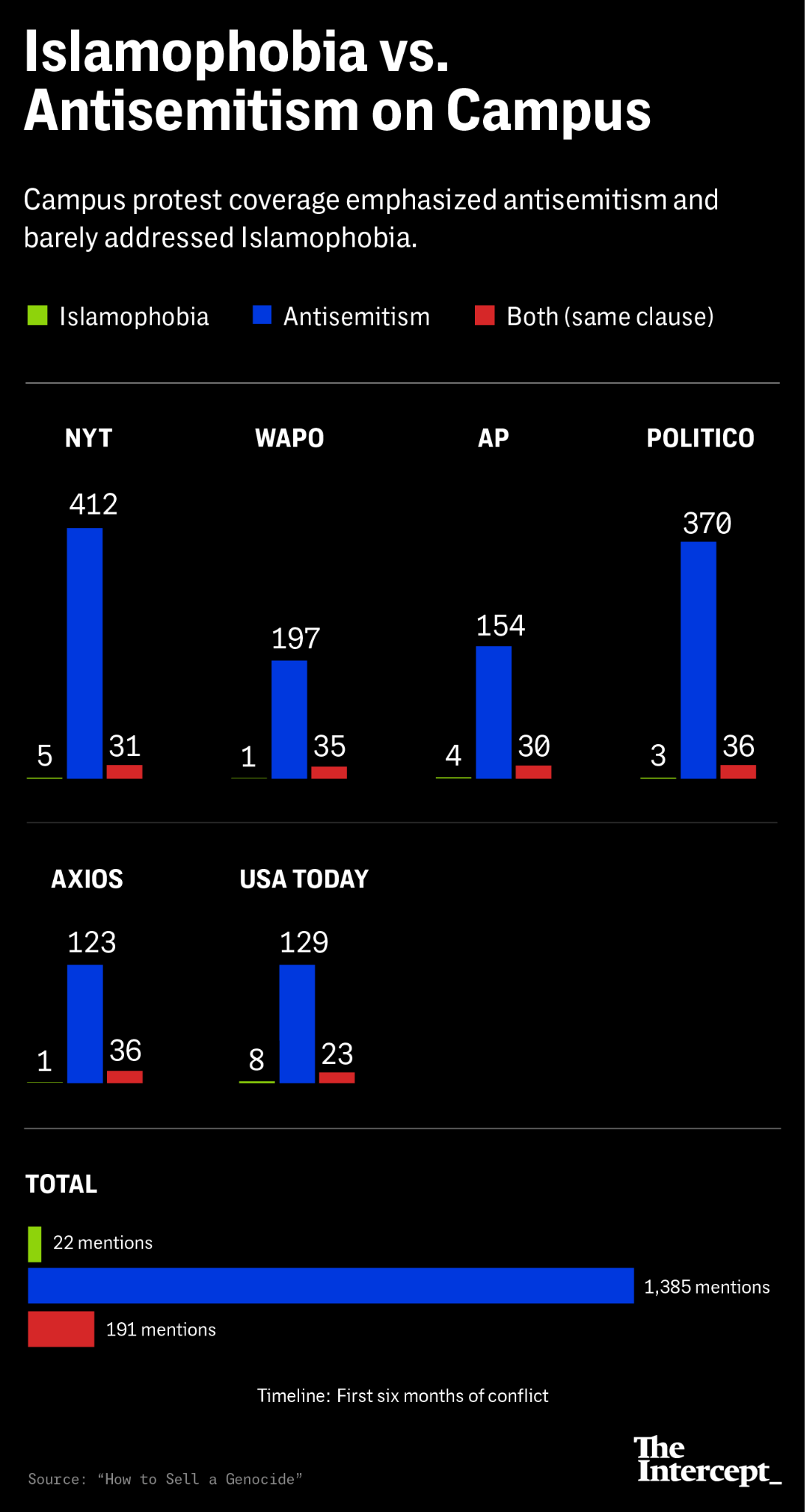
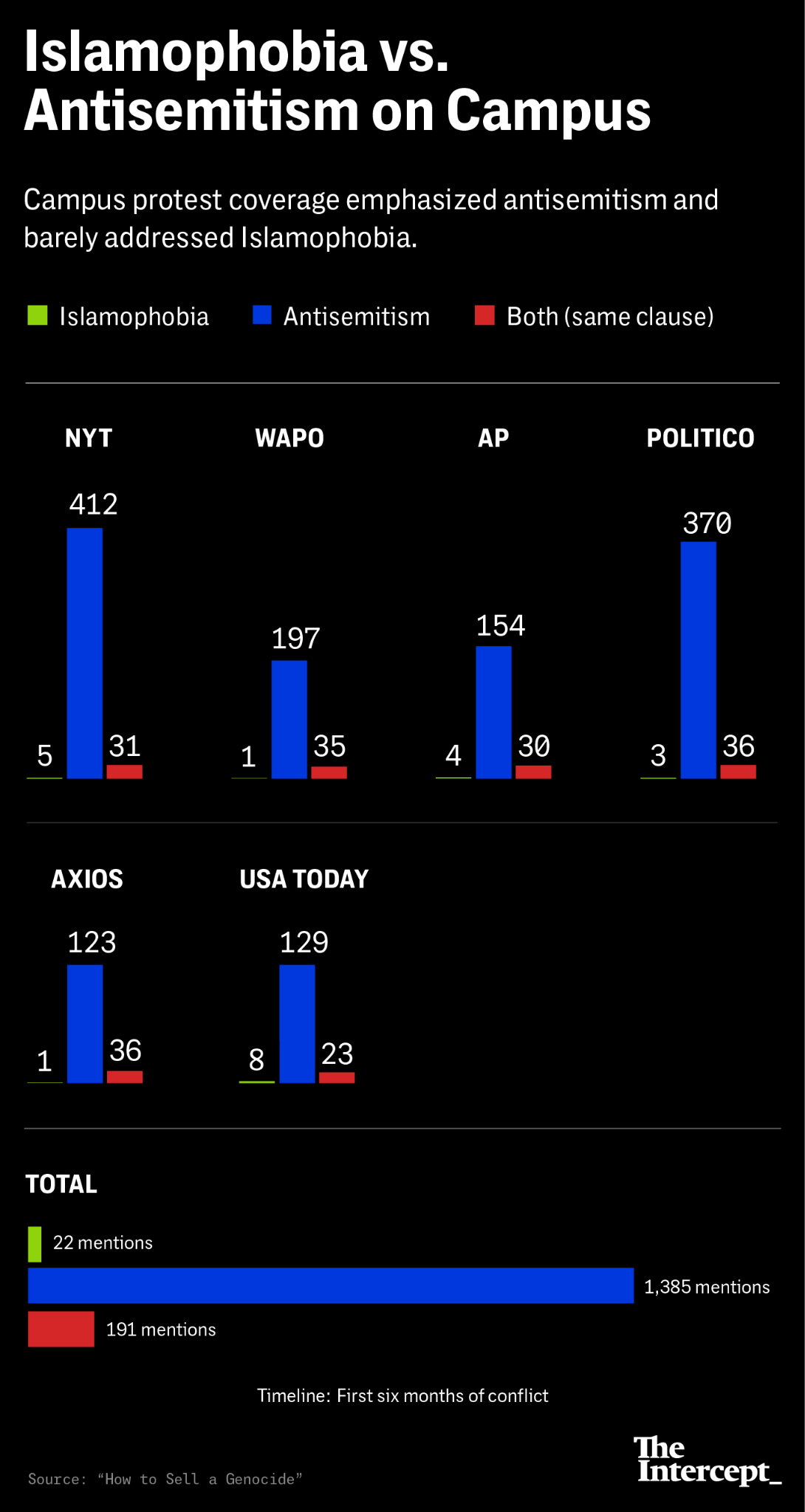
    A similar asymmetry is evidenced in the one-sided coverage of antisemitism vs Islamophobia in US media, in particular when it comes to incidents on college campuses. As I also document in my book, despite campus surveys on the topic finding roughly equal amounts of antisemitism and Islamophobia on major college campuses, the former was covered 63 times more than the latter, for 22 stand-alone mentions of Islamophobia, versus a staggering 1,385 stand-alone mentions of antisemitism in major US media outlets during a six month survey period.

    Data point after data point shows a consistent and undeniable truth: Arab and Muslim lives, and Palestinian lives in particular, simply don’t matter. Their humanity is negotiable, their racial discrimination is a nonevent, and open support for their dispossession and statelessness is not only not a scandal, it is simply never acknowledged. El-Sayed is right that no one will ever ask him if Palestine has a right to exist, because to do so US media would have to see Palestinians as fully human first and they categorically, empirically, do not.

    (more…)

  • US provides $300 million in earthquake recovery money to Venezuela while sitting on $8 billion in stolen oil wealth

    US provides $300 million in earthquake recovery money to Venezuela while sitting on $8 billion in stolen oil wealth

    Rescue workers find corpses amid the rubble in Macuto, Vargas state, Venezuela, on July 5, 2026, following the June 24 twin earthquakes. Photo by Raul ARBOLEDA / AFP via Getty Images
    Common Dreams Logo

    This story originally appeared in Common Dreams on July 06, 2026. It is shared here under a Creative Commons (CC BY-NC-ND 3.0) license.

    The Trump administration has seized at least $8 billion worth of Venezuela’s oil wealth since it overthrew President Nicolás Maduro in January, according to the New York Times.

    Now, as Venezuela struggles to cope with a catastrophic pair of earthquakes late last month that killed at least 3,300 people and left tens of thousands more injured and homeless, and 41,000-50,000 people are reported missing, the US is providing just $300 million in humanitarian aid, a small fraction of the money it purloined.

    The Associated Press reported on Monday that international rescue teams have begun to pull out as hopes of finding missing loved ones alive dwindle each day after the disaster.

    Shortly after deposing Maduro, US President Donald Trump declared that the US “took over Venezuela… and the oil is flowing.”

    Economist Francisco Rodriguez has found that during the first quarter of 2026, after Trump overthrew Maduro and the US began expropriating Venezuelan oil, the country experienced the lowest rate of economic growth since 2021, even as oil exports rose.

    As Roxanna Vigil, a former senior sanctions policy adviser at the US Treasury Department’s Office of Foreign Assets Control, explained in an article for the Council on Foreign Relations last month, “almost 100 million barrels of oil worth an estimated $8 billion have flowed through a process marked by no transparency and minimal oversight.”

    “While the Trump administration has repeatedly framed this control as benefiting both countries, it has not publicly disclosed how much Venezuelan oil it has sold, how much revenue it has collected, or how it has used those funds,” she added.

    According to an initial report by the United Nations Development Program, the quakes caused $6.7 billion worth of damage.

    Former US Ambassador to Venezuela Jimmy Story credited what he said was a “robust” US effort to provide aid. But he told Reuters that it called into question “the transparency over the oil fund,” and asked, “Will these funds be released for the disaster response?”

    The Times noted that the Trump administration’s response to the Venezuela quakes is dwarfed by the humanitarian response to the earthquake that struck Haiti in 2010, when the US launched a more than $3 billion relief effort and deployed more than 7,000 troops.

    Just 900 US troops are on the ground in Venezuela, with another 800 positioned in Puerto Rico and Curaçao to support the operation.

    The Times’ Simon Romero, who has reported on earthquakes in both countries, noted that the Haiti earthquake was more destructive, but said:

    The parallels between the disasters are also haunting: Pancaked multistory concrete buildings, bodies flooding into overwhelmed morgues, survivors disparaging government responses, and civilians leading desperate rescues of people trapped in the rubble.

    Viewed against cityscapes clouded by dust from pulverized structures, the images speak to hollowed-out first responder agencies, generalized impoverishment, and political dysfunction in both Haiti and Venezuela.

    Beyond the $8 billion taken out of Venezuela since January, anti-war and human rights groups in the US have urged the Trump administration to lift the economic sanctions that have crippled the Venezuelan government, arguing that they have hobbled the recovery effort.

    The Washington Office on Latin America (WOLA) estimated that during just four years, between 2017-20, US sanctions caused the Venezuelan state to lose between $17 billion and $31 billion in revenue.

    A more recent report by the Tricontinental Institute for Social Research found that between 2017-24, Venezuela suffered an estimated $226 billion in lost oil revenue due to US sanctions, equivalent to 213% of its total gross domestic product.

    (more…)

  • Rebels with a cause: The Black Panther Party and socialism in practice

    Rebels with a cause: The Black Panther Party and socialism in practice

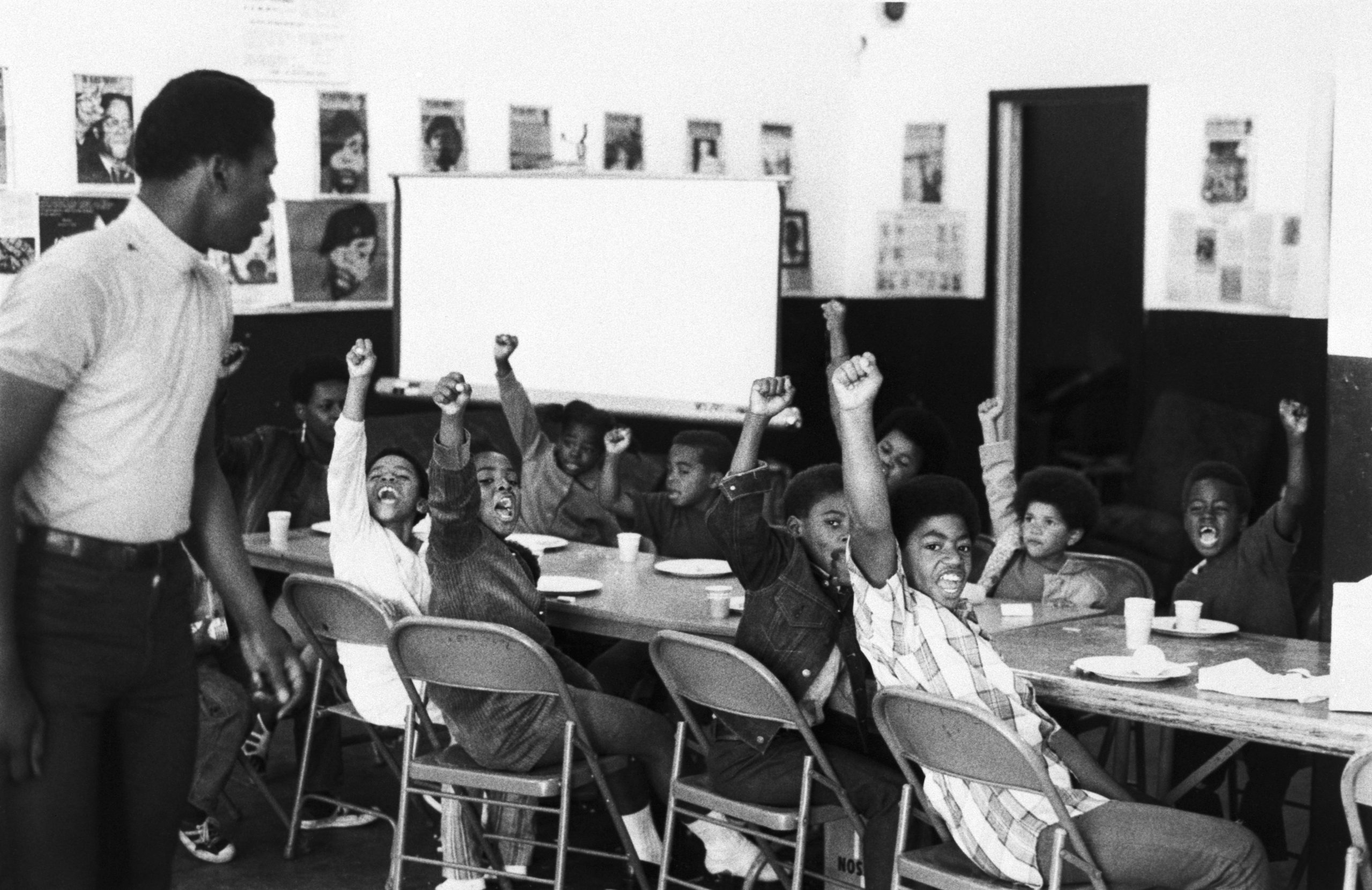
    A teacher leads his students with the black power salute and slogans at a Black Panther liberation school. Photo via Getty Images

    On this episode of Rattling the Bars, to commemorate the 60th anniversary of the founding of the Black Panther Party in 1966, host and former political prisoner Mansa Musa speaks with Dr. Joy James and Dr. K. Kim Holder about the history of the Panthers and their unique approach to, and practice of, communal socialism.

    This is Part 2 of a two-part conversation. Watch Part 1 here.

    Guests:

    • Dr. Joy James is Ebenezer Fitch Professor of Humanities at Williams College. She is the author of numerous books, including: In Pursuit of Revolutionary Love; Resisting State Violence; and Shadowboxing: Representations of Black Feminist Politics. Creator of the digital Harriet Tubman Literary Circle at UT Austin, James is also editor of The New Abolitionists: (Neo)Slave Narratives and Contemporary Prison Writings; Imprisoned Intellectuals; Warfare in the American Homeland; The Angela Y. Davis Reader; and co-editor of the Black Feminist Reader.
    • Dr. K. Kim Holder is an assistant professor of educational foundations and Africana studies at Rowan University. Dr. Holder earned his doctorate from the University of Massachusetts Amherst in Multicultural Education and African American Studies, his masters in Early Childhood Education from Bank Street College of Education, and B.A. in History from Hampshire College.

    Credits:

    • Producer / Videographer / Editor: Cameron Granadino
    Transcript

    The following is a rushed transcript and may contain errors. It will be updated as soon as possible.

    Mansa Musa:

    Let me ask y’all this. We know that at this juncture right now where we stand at right now, the contradiction that exists between the leadership or the lack of leadership in this country, because when we come into space saying like we saying socialism, we defining and we making an analysis and we using it in our analysis, Bernie Sanders, Franklin Roosevelt, except Obama. Let’s move with the narrative. Let’s move the needle to how do y’all look at the Black Panther Party’s perspective in terms of socialism and how they was trying to implement their ideas along them lines? What’s the lesson we can take away from that to help people understand that?

    Dr. Joy James:

    Well, I could just say from my research and a little bit from organizing and Kim, correct me, right? Check me if I’m wrong. I think there were different parties after the assassination in Chicago with Hampton and Mark Clark, with Fred Hampton and Mark Clark in 69 and then their attempts to do additional assassinations a week later, I think December 11th in Southern California, Geronimo Pratt had fortified the house. So there was exchange of fire but nobody was killed in peaches. I can’t remember her full name, but Kim Can. When I think of that kind of history, I understand that it’s not going to be replicated whatever we end up doing as older people or younger people 50 years later, but there’s a continuous line. I’m sorry if I’m sounding too abstract, but what I see and what happened decades ago when I study it, when I work with my students, look at it, when we look at the documentaries and the films, I see a spirit and I know people usually don’t talk about spirit and we talk about material struggle, but there’s also a spiritual aspect to liberation movements.

    I think the youth have that embodied in them as well as we have it. It doesn’t come out with the same kind of narrative, but it’s going in the same kind of trajectory. I think that becomes a source that allows us to say we need to keep jobs, to keep family, whatever fed, but we do not need to pimp ourselves out in terms of politics and we don’t have to lie about the reality. So it doesn’t matter if you get a black man or a black woman as president, whatever, it’s still an imperial project and it’s going to continue to decimate countries and peoples around the globe and people inside the US. And I believe when we agree to that and we understand that agape, I’m a former seminarian. When we think of agape, which is a form of love, which is about sacrifice for the greater good, I think our capacity to resist just increases.

    I think what diminishes our capacity is that we have different pods of activists and radicals and abolitionists. And sometimes people want to hold onto their brand and their

    Mansa Musa:

    Identity

    Dr. Joy James:

    Rather than to let it go and to merge and try to create something that takes us somewhere beyond just circling around the camp. I don’t know if that was too abstract.

    Mansa Musa:

    Nah, nah, that was very astute and it’s a good observation because when we look at, and I’m going to go back to what you say, like it’s more than one party. My perspective about that is I’m in the space of that we didn’t understand the repression. We didn’t understand our opposition in response to who we were, the most fierce party in the country. We didn’t understand the response that we was going to get and not understand the response and making adjustments and then we making the adjustments as we go along and the adjustments is being made in response to like, oh, misinformation, disinformation, like you talk about Geronimo, he did all that time in prison. Why? Because somebody wouldn’t come forth and say, because the misinformation and disinformation, we killed each other from on coach to the next coast. Why? Because misinformation, discipline.

    Now we going from a position of organizing people to trying to survive. I’m not idealistic about … I don’t have that idea. I’m looking at the reality. Eddie Conway did close to 47 years in prison and nobody came and gave him no money. It was a lot of comrades that went to prison and didn’t get the support they supposed to got. That being said, our ability to respond to the repression put us in a position where we went from being on the offense in terms of organizing to them being on defense, then from being on defense to just trying to survive, trying to live.

    Dr. K. Kim Holder:

    I think there was a party. I think I would say from 67 until the marital candidacy where they shut down all the branches and brought them there, I think that’s where you stop talking about one party. I think it was a party. I know it’s populist say there was many different parties. There was one party, it was a revolutionary party. It had communist socialist trends to it. I believed in armed self-defense, believed in revolution. And you just go back to Youi Newton’s on revolution, executive mandate number one, two, three, et cetera, et cetera. So I think there was a party. I think there was a consistency. And I want to say this, while the youth got no clue what the party was about but love it, they got the essence.

    Mansa Musa:

    And the

    Dr. K. Kim Holder:

    Essence of what they like is that the party were no punks, they were no sellouts. What you got was true. It may have been made mistakes, but it was true struggle and they didn’t have no alternative agendas.

    Mansa Musa:

    Agenda, yeah. And I think

    Dr. K. Kim Holder:

    That’s what the youth see and what the party represents to them. They ain’t got no clue about all socialism, communism, revolution versus this. They grew up thinking they was free because of Obama and stuff, but what they do see was the party was uncompromising and that’s the essence of what they see of that. And that’s a good thing. But I do think that there was a party message. There was a party and it was a revolutionary party and I agree with you. It takes its place in historical continuing of Black liberation

    Mansa Musa:

    Along

    Dr. K. Kim Holder:

    With Nat Turner and what have you.

    Mansa Musa:

    Eddie wrote a book called The Greatest Thread Ever. But who would say the greatest, say the most fearful thing, two things of the party that he wanted to completely get rid of, free breakfast program and the Back Panther Party paper. He was systematic and trying to get rid of both of those entities because they had root in the community and the free breakfast program, sickle cell anemia test, all those institutions, those institutions was like started party members would go there and set it up, but ultimately they would phase themselves out when somebody in the community stepped up to start taking responsibility and we would just provide the services and the resources, but the whole goal was, the whole goal was to- For the people

    Dr. K. Kim Holder:

    To

    Mansa Musa:

    Take over. … turn it over to the community. Exactly. So that the community and then we would be in a position like it would provide security or help. What can some of the lessons that the young people can take from the party going forward if they was to ask you that question, what can I take away? What can be my take? What should I look at? Watch your

    Dr. K. Kim Holder:

    Back when

    Mansa Musa:

    You

    Dr. K. Kim Holder:

    Start organizing. I’m telling you, when you start organizing,

    Mansa Musa:

    You

    Dr. K. Kim Holder:

    Develop your underground, you’ve developed your railroad first.

    Mansa Musa:

    And

    Dr. K. Kim Holder:

    No matter what happens, that is going to be the ultimate thing they’re going to come after you and that you need to organize and structure yourself in a way where there is a railroad and that we can operate outside of that is ultimately … We say, oh, the party had disinformation and stuff. You know what? The system did their job. We was revolutionaries and they came after us, which is what they supposed to do. And we are the ones that have to come. My thing is that their ability to pay us off,

    But we need for them to understand now because just two years ago they thought everything was rosy. They need to understand that you start out with developing the railroad first, that you develop stuff in a manner in which you know that it’s not always going to be hunky-dory all up front and that you make sure that you understand that when you’re developing the most simplest things like the free breakfast program, like the free clinics and stuff, we got to understand the nature of this system. I don’t want to get all gloom and doom, but that is something that I’ve been dealing with for the last 60 years in terms of what the system … The system did what they were supposed to do and they’re nastier now.

    Dr. Joy James:

    Yeah. I would say to the youth, that’s their question, right? What would we say to the youth? So it’s almost like I’m talking to my students. Check out a number of the documentaries, All Power to the People, Black Panther Party and Beyond by Lil Lee. I was introduced to that by Kim Holder when they came to Boulder to a conference in 1997 or something. And it’s important. It’s online and I don’t think a lot of people know about it, but you could see the party, its evolution, and also the contradictions within it. Then there’s another film, The Spook Who Sat By The Door, which is not a documentary.

    Mansa Musa:

    Yeah, Samuel Greenlee.

    Dr. Joy James:

    Yep, you got it. And it’s an interesting film.

    I think for young people who are … I’m a military brat, so I grew up and I was in R2C handling stuff. Some people want to be pacifists and that’s fine. So the understanding for me is that the revolutionary is really based in the heart and that what you’ve talked about, the food programs, the sickle cell anemia, the healthcare, knocking on people’s door, providing housing. I know from Kim talking their sister was being harassed in Hell’s Kitchen decades ago when he was in the party by the Hell’s Angel and Kim being in the party came to her apartment and slept on her floor to give protection so she wouldn’t be harassed or kicked out of her apartment by some racist people on motorcycles. Those expressions of love and commitment builds of movement, but there’s a cautionary note because we referenced Geronimo. Huey was brilliant and there’s a book out on Huey Newton that’s coming out in a couple of months.

    And again, I never sacrificed or wasn’t old enough or whatever the reasons for not being there, but they’re the contradiction sometimes of leaders who lose their way and we have to have the capacity to pull them back. Geronimo did 27 years the same as Nelson Mandela. People cheered Nelson Mendela. They don’t remember what happened to Geronimo, how he was framed, how he was at a meeting in Northern California,

    Anthers. FBI set him up and Huey told people not to acknowledge the person who went rogue was Kathleen Cleaver. And so she ends up being with Stuart Hanlin and Johnny Cochran, part of that legal team to get Geronimo out. And I only met him once, but people have suffered a lot and people have given a lot, but what they’ve left is a legacy for us to study, whether you’re young, middle-aged or old. And I don’t think the Panthers were ever defeated. And I think that’s why there’s so many people focus on them. The last thing, which is more a question, from what little I looked at, there was an organization that identified young people as Panthers and then they were told to stand down and they became Black lions. I would hope that the party has the fluidity to embrace everyone who’s sincere about … And I don’t know these people, they’re based in Philly.

    I’m not in Philly, but I would say that to the candor that we have to deal with our contradictions despite the predatory violence of the state and people trying to buy out movements, we still have our inner mental, emotional registers that have to be calmed down. And so then I think of care, protest, movement, marinage, war resistance. That’s the whole thing I’ve been thinking about for a decade about the captive maternal, which is ungendered. And I see you both as captive maternals that you care. And I think that foundation of care will push us through into liberatory struggle.

    Mansa Musa:

    Let’s talk about how do we get young people to understand how the coalition built in terms of … Because the party, when they came into existence, they was big on coalition building. They was big on networking, they was big on any element that was anti-stagement or was protesting conditions. They network with them and build a relationship with them in order to change the conditions that our communities found themselves in. How do we get young people to understand that part of the party’s organizing strategy?

    Dr. K. Kim Holder:

    I think one thing I can only come from it from a negative perspective, unfortunately, but I think one thing that needs to stop, people tend to define their ideology by criticizing other people.

    Mansa Musa:

    Come

    Dr. K. Kim Holder:

    On. And I think that needs to stop. And what we need to start to do at the beginning is we need to start to develop some basic principles that we accept and that we live by

    Mansa Musa:

    And

    Dr. K. Kim Holder:

    That that allows us then to determine how we can go with somebody else. Right now we seem to be, “You said this one thing five years ago, you ain’t no good, blah, blah, blah.” It’s like, I show how bad I am by showing that as opposed to let’s establish what we actually believe some basic principles and then some basic principles of operation, how we can interact with each other and move forward. Why do we expect us to get along? Nobody gets along in this society. Because we have it be movement people, we get along. So we got to start basically on what are the basic principles so then we don’t be one ups on people.

    Dr. Joy James:

    We need to articulate, well, you already did the 10 point program, right? But we need to articulate for this generation, this century, what is emotional intelligence? I mean, we know little Bobby Hutton, I mean, Eldridge thought it was a good idea to do something and you lose people or people get disappeared. There’s a way in which even when we struggle at our best, and again, I was not in the party, but I know Kim from talking to you for 30 years a little bit about what you were saying. There’s a way in all political struggles when you’re being hunted by the state and you’re being infiltrated, there has to be a level of integrity or a set of ethics that’s not just from the party. It has to emanate from ourselves as a community. And that is how we all get to make mistakes and we all get to like, “I got to step this one out.

    I’m not brave enough,” whatever. “Okay, come back next week and we’ll try again. “But I’m not sure that we’ve articulated beyond the 10-point program, what are the ethics of emotional intelligence and a commitment and agape? And I know for some people that seems very abstract, but I think that’s the core that keeps us alive and from cross-shooting each other literally and figuratively.

    Mansa Musa:

    And to your point, we do this because we love it. We love our people. We love the fact that we’re in a position to try to do something to gain our freedom and our liberation. I was in Oakland and had the opportunity. I told Emory Douglas, Minister of Culture, Black Panther Party when I came back because we was doing some things and I told him when I come back, I wanted him to take me around Oakland and talk about the party and some of the early things they did and he’s a good storyteller as far as I’m concerned and he did. He took me around with the thing that he left me with was how simplistic the party was in terms of organizing how simplistic … He said every library in Oakland, wherever they had something party members was there and participating and any space they could get, they would be there.

    Any park, they would be at, they would do organized, they would play baseball, basketball. They always was doing something in the community. And I think that to your point, Kim, that we have to stop talking about what we don’t have in common and start talking about what we do have in common and find that commonality and then find that commonality.

    That’s just what we do. I’m going to give you one more example, then I’m going to give you all that y’all have the last word. Dominique Conway, Eddie’s wife, we was doing some organizing in the neighborhood. So in the neighborhood we in high drug area, there’s a lot of kids there. So we down there doing some organizing and we don’t have no space. So they said,” Well, we got to get us a space. “So we took a house, a house that was abandoned, that was livable. We took it, did all the research on it, found it was city property, took it and then held a press conversation like this house we taking for the community. And when Eddie got out, that became our base operation. We did everything in that neighborhood. Eddie in a meeting with some guys and they talking like they serious about organizing.

    And so Eddie looked out the window and seen some abandoned house said,” Just go take some houses and do just that simple. “And I think that we lose sight on the simplicity of things that we could be doing, but y’all got the last word, what y’all want to say about this subject matter.

    Dr. Joy James:

    I want to say thank you for inviting us to this conversation and for all the work that you’re doing and all you’ve contributed. And I was just thinking of a book, the importance of books, which we know many people inside and people who were in the party studied books, they read, they taught themselves, they taught each other. And so it was a book, it was a black women’s led book launch in the federal government building or something on 125th Street in Harlem. And I went there because it was a Sada’s memoir and it’s the first time I heard of her book was just coming out. And then when I went to teach at UMass, someone mentioned to Kim who got his degree from there that I was teaching this book, Asada, he autobiography and class and that’s how we met. That’s how the conversation started.

    So the word is with us.

    Mansa Musa:

    Right.

    Dr. Joy James:

    Yeah. Yeah, you’ve got it. And even what you’re doing- And

    Dr. K. Kim Holder:

    She took me to Cuba

    Mansa Musa:

    And

    Dr. K. Kim Holder:

    I took her to the sister. Hey,

    Mansa Musa:

    The word became fresher. The word became fashion. Yeah. I picked up on that look and the word became flesh.

    Dr. Joy James:

    And that’s what you’re doing now. You’re doing it with audio, but it’s still the word. Yes, that’s how I got to be in her kitchen and hear her say things. I’ve been in Cuba several times, but always like the collective, we’re all sitting, we’re tourists and something like that. But because they were both in the party in Harlem, that’s when you get these … This is when you learn. And I learned a lot and I’ve learned a lot from the party and a lot from how you’ve cared and loved and fought and so I’m grateful and thank you again.

    Dr. K. Kim Holder:

    You work with Eddie and you was in the joint, so that’s one perspective. Eddie was good with coalitions. Do not follow the party when it comes to coalitions. Party was Vanguard. We bossed everybody around and half the coalitions that we talk about, we made up.

    Mansa Musa:

    Yeah, okay.

    Dr. K. Kim Holder:

    I’m

    Mansa Musa:

    Just

    Dr. K. Kim Holder:

    Saying.

    Mansa Musa:

    The

    Dr. K. Kim Holder:

    Party and especially if you were black, if you were something else, we would deal with you. But if you were black, how come you ain’t a pather?

    Mansa Musa:

    Yeah.

    Dr. K. Kim Holder:

    You say? If you was Latino, okay, we could work with you. If you was white, okay, if you was this, but if you’re black, how come you ain’t a path? The only blacks that we respected outside of us was students. But I understand that prison was different and I know Eddie Conway is a good coalition builder, but so you getting the good side of the party,

    (more…)

  • ‘A pathetic power grab’: Trump purges bipartisan election assistance commission

    ‘A pathetic power grab’: Trump purges bipartisan election assistance commission

    U.S. Election Assistance Commission Vice Chair Christy McCormick (R), accompanied by U.S. Election Assistance Commission Chairman Thomas Hicks (L), speaks during a House Administration Subcommittee on Elections hearing on Capitol Hill on May 20, 2026 in Washington, DC. Photo by Andrew Harnik/Getty Images
    Common Dreams Logo

    This story originally appeared in Common Dreams on July 10, 2026. It is shared here under a Creative Commons (CC BY-NC-ND 3.0) license.

    US President Donald Trump late Thursday forced out the remaining three members of an independent, bipartisan commission that assists state election officials across the country, a move that critics condemned as a “pathetic power grab” ahead of the 2026 midterms.

    The two Democratic members of the Election Assistance Commission (EAC), Benjamin Hovland and Thomas Hicks, were fired, and Republican Commissioner Christy McCormick resigned at the White House’s request, according to ProPublica. The agency, established by Congress more than two decades ago, now lacks leadership and any ability to make decisions, just months before the 2026 elections.

    The EAC, as its website states, is “an independent, bipartisan commission whose mission is to help election officials improve the administration of elections and help Americans participate in the voting process.” In an executive order last year, Trump ordered the EAC to implement proof-of-citizenship requirements in the federal voter registration process, along with other changes. The president’s effort to impose his policy demands on the EAC was mostly blocked in federal court.

    Trump, who has said he wants his administration to “take over” voting nationwide ahead of the 2026 midterms, has since taken other steps that watchdogs and Democratic lawmakers say amount to an attempt to preemptively subvert the coming elections, including a sweeping assault on mail-in voting—which is also facing legal challenges. Legislatively, Trump is pushing Republicans to pass the SAVE America Act, a bill that experts say would prevent millions of Americans from voting.

    Michael Waldman, president and CEO of the Brennan Center for Justice, said Thursday’s EAC firings “are deeply concerning in light of President Trump’s relentless efforts to try to interfere in elections.”

    “These removals leave the agency without leadership and unable to carry out its major responsibilities,” said Waldman. “The guardrails Congress placed on this agency are clear and must be followed: The Election Assistance Commission was designed to be bipartisan with four members, no more than two of which can be from the same political party. The agency cannot make any significant decisions or take any significant actions unless three confirmed commissioners agree. Until bipartisan replacements are confirmed, the agency cannot lawfully make any decisions that affect how Americans vote.”

    Lisa Gilbert, co-president of Public Citizen, said Trump’s termination of EAC commissioners underscores that “he’s scared of the voting power of the American people.”

    “This move is another pathetic attempt to sow doubt in our elections, which are safely and expertly run by states and localities,” said Gilbert. “This agency deserves a steady hand and expert leadership. That said, it is important for voters to know that states and localities, not the EAC, run our elections. Even more importantly, it is the voters who decide who takes office.”

    The EAC firings came less than two weeks after the conservative-dominated US Supreme Court handed Trump the power to purge independent agencies at will with its Trump v. Slaughter ruling, erasing around 90 years of precedent.

    Election law expert Rick Hasen warned in a blog post on Thursday that Trump “could try to direct the commissioner-less EAC to do his bidding, for example by stating that the EAC must amend the federal voter registration form that states must accept for federal elections to include documentary proof of citizenship.”

    “Trump’s first voting-related EO tried to do this, and he was stymied. But that was acting through the commissioners and before the Slaughter case,” Hasen noted. “If he tries anything like this, it will be high-profile and very important litigation that will end up at the Supreme Court on the emergency docket over the summer.”

    Adrian Fontes, Arizona’s Democratic secretary of state, said in a statement late Thursday that the EAC purge was “irresponsible and dangerous,” accusing the administration of remaining “dead set on causing chaos for our election officials across this country.”

    “This move undermines the integrity of nonpartisan election administration,” Fontes added.

    (more…)

  • Israel is murdering Dr. Hussam Abu Safiya. The US media is covering up the crime.

    Israel is murdering Dr. Hussam Abu Safiya. The US media is covering up the crime.

    Activists gather to stage a protest demanding the release of Dr. Hussam Abu Safiya, director of Kamal Adwan Hospital, in Tel Aviv, Israel on July 06, 2026. Photo by Saeed Qaq/Anadolu via Getty Images

    This story originally appeared in Mondoweiss on July 08, 2026. It is shared here with permission.

    By now, editors at the New York Times and producers at CNN are surely squirming over what to do about Dr. Hussam Abu Safiya, the Gazan doctor and hospital director who Israel has locked up for a year and a half without trial, and who says his jailers are trying to kill him.

    Worldwide campaigns, by Amnesty International and other human rights groups, have called for Dr. Abu Safiya’s release and global media coverage has been significant. Britain’s flagship newspaper, the Guardian, has naturally already reported about Dr. Abu Safiya. Here is its July 6 headline: “Detained Gaza doctor almost unrecognisable after injuries in Israel jail, lawyer says.” Even the Israeli press have reported about him, including covering a demonstration in Tel Aviv on July 6 drawing attention to his case.

    But in the American media, there has been a complete blackout about his case and his dire condition.

    As of July 7, the New York Times has not mentioned his name a single time since January 2025. The Washington Post did run an Associated Press report, but there was no fanfare on the Post home page and you had to search hard for the article. In the Wall Street Journal so far: nothing. CNN’s website did have a short video report, but it apparently never appeared on the network’s U.S. outlet. Dr. Abu Safiya is also missing on MS Now, supposedly the most progressive cable network.

    As this site and other alternative media have regularly reported, Dr. Abu Safiya, a pediatrician who was the administrator of the  Kamal Adwan hospital in Gaza, turned himself in to the Israeli army on December 27, 2024. There is an iconic photo of him, in his white physician’s coat, walking through the rubble in Gaza toward an Israeli tank. (Somehow that photo has never made it into the New York Times.) Since then, first-hand accounts from his lawyer and now his son have alerted the world about his terrible treatment in various Israeli jails and his physical deterioration. Dr. Abu Safiya, now held in Rekefet Prison, has said: “They’ve brought me here to kill me. I don’t see myself surviving. This is the end.”

    Israelis have insinuated that Dr. Abu Safiya is somehow linked to Hamas, but he has never been charged with any crimes. But the media is not supposed to decide on his guilt or innocence before reporting on his jailing. Hiding the story of Hussam Abu Safiya is clearly pro-Israel censorship, and unfortunately all too characteristic of America’s newspapers and cable networks in their coverage of Palestine.

    What’s more, the U.S. media is also covering up a much bigger story. Dr. Abu Safiya is being held without trial, in what Israel euphemistically sometimes calls “administrative detention.” Precise figures are hard to confirm, but Amnesty International has estimated that at the end of 2025 Israel was holding 4,622 Palestinians, from both Gaza and the occupied West Bank Palestine, without putting them on trial. 

    Dr. Abu Safiya’s terrible situation, which even just by itself is newsworthy, could also serve as a news peg to write about Israel’s administrative detention policy. National Public Radio, to its credit, did just that back on May 30. Its excellent on-air report even interviewed Dr. Abu Safiya’s son, Ilyas. 

    Mainstream media reporters based in Israel who want more background could drop into the offices of Israel’s premier human rights organization, B’Tselem, which monitors the detentions, even though Israel’s government no longer gives them the figures. Here’s one of their reports.

    What’s extraordinary about the U.S. self-censorship is that the Israeli media has reported about Dr. Abu Safiya’s plight. Haaretz, Israel’s newspaper of record, even ran an editorial charging the Netanyahu government with mistreating him and others, and urged Israeli courts to “halt the ongoing starvation, abuse and imprisonment.” And even the more right-wing Times of Israel has at least recognized his existence.

    What explains the cowardice at the New York Times and at CNN? Even those of us who have spent years monitoring the distorted and dishonest U.S. coverage are stupefied. 

    (more…)

  • In a divided country, U.S. residents agree on one thing: no data centers 

    In a divided country, U.S. residents agree on one thing: no data centers 

    Rural Michigan residents rally against the $7 billion Stargate data center planned on southeast Michigan farm land. Photo by: Jim West/UCG/Universal Images Group via Getty Images

    This story originally appeared in Prism on June 29, 2026.

    Across the country, politicians are starting to heed the public’s concerns about data centers. 

    Almost 75% of Americans across the political spectrum oppose constructing data centers near their homes, according to a recent Gallup poll. A majority—63%—are concerned by federal regulatory agencies’ practice of approving projects without first evaluating environmental and public health concerns. 

    These numbers not only paint a stark picture of the massive backlash to the rapid and rapacious buildout of data processing facilities (some of which consume enough energy to power a midsize city), but they’re also an indicator that the public feels very differently than the corporations pushing for their construction. The country has never been more divided, but on data centers, residents agree: It’s time to pump the brakes. 

    Communities that are already forced to contend with the consequences of data centers warn of their near-constant noise pollution, voracious consumption of water, and discharge of pollutants into local ecosystems. However, it’s not just environmental concerns that undergird the community-led protests against data center development. Many are also concerned about how data centers come to fruition—often through violations of democratic processes in the form of shadowy backroom deals and nondisclosure agreements. There’s also the continued rise in utility rates at a time when nearly half (49%) of American households don’t make enough money to cover expenses. Americans contend with issues of drought, fossil fuel dependence, and habitat loss. Generational farmland is being gobbled up to prop up acres of data warehouses. The list goes on. 

    Three years after OpenAI’s artificial intelligence (AI) tool Chat GPT forever changed the world’s orientation to computing, governments are responding to community needs for more information by implementing temporary moratoria on the construction of potentially harmful facilities. 

    “I would say this is the fastest I’ve ever seen [the legislature] move,” Pricey Harrison, a North Carolina state representative, said about her state’s approach to data-center regulation. “The reaction has been, I think, fast enough to do something about it. Thirty North Carolina municipalities—and counting—have considered or approved data center regulations and moratoria. 

    Where do other moratoria stand? Here’s what to know.

    States catching up with local government 

    Fourteen states have either introduced, passed, or rejected data center moratoria legislation, according to the National Conference of State Legislatures. A bill introduced in South Dakota would prevent new construction or expansion of hyperscale data centers for one year. Another in Oklahoma would pause data center construction until November 2029 to allow the legislative body to study impacts. Pennsylvania’s legislature is currently considering a three-year moratorium on new hyperscale centers. 

    Harrison introduced North Carolina’s legislation on a moratorium, though it didn’t get traction. “My hope was that it was about putting a stop to them until we had the guardrails in place,” Harrison said.

    No moratorium has been signed into law at the state level, though one in New York, which would halt data center construction for three years, is sitting on the governor’s desk. Another in Maine was vetoed by Democratic Gov. Janet Mills in April. 

    In March, Sen. Bernie Sanders and U.S. Rep. Alexandria Ocasio-Cortez, introduced federal legislation aimed at curbing the supercharged expansion of data centers, which the officials argue are a threat to millions of jobs and planetary health. Last year, Sanders presented a report to the Senate Committee on Health, Education, Labor and Pensions that artificial intelligence and automation could replace nearly 100 million jobs in the U.S. over the next decade. For perspective, there are approximately 170 million employed people in the country, per the Bureau of Labor Statistics. 

    The greatest success in passing moratoria has been found at the local level. 

    The benefit of a moratorium  

    A moratorium on data center construction and expansion is not a ban. An outright ban has only been achieved in one place in the country: Monterey Park, California. In the June election, 86.3% of voters approved a ban on data centers. “We hope that other communities will use the model set by residents here in Monterey Park as inspiration to stop datacenters from encroaching in their backyard,” Monterey Park city councilmember Jose Sanchez told The Guardian.

    As Prism previously reported, corporations benefit enormously when they can build data centers as quickly as possible because it diminishes the risk of public pushback. Companies lobby for environmental agencies to reduce the regulatory review process for construction of destructive facilities, support state legislation that hampers a local government’s ability to implement cautionary legislation, and prevent public officials from discussing ongoing negotiations for permits. By the time the public finds out about a planned facility, cement is already in the ground.

    Mitch Jones, managing director of policy and litigation at the government accountability organization Food & Water Watch, told Prism that what’s needed is more information. Construction and operations of data centers have been a black box, and residents need to know what’s happening to their local resources in order to protect themselves. 

    “The stronger moratoria are the ones that, one, last longer and thus give time; and two, require real detailed studies of the various impacts that data centers have in communities and states,” Jones said. “We don’t believe that these studies can be hurried, or we’re going to get the policy wrong.” 

    Pushing back against industry talking points

    After Mills, Maine’s governor, vetoed the country’s first bipartisan bill on a data center moratorium to favor the construction of a data center in the town of Jay, the company behind the facility pulled out, and cities got to work passing their own moratoria. 

    Bill Pluecker, a local representative in Maine, told Prism that in May, his town of Warren proposed its own moratorium in response to Mills’ veto. A special town meeting is now scheduled for July 8 to determine whether to enact the moratorium. 

    “I think she wasn’t nuanced or wasn’t looking at the way that AI and data center development is different than a Walmart going in, or different from what we all really want in Maine,” Pluecker said.

    According to Pluecker, this moment of data-center expansion requires more political discernment and a shift in approach to economic stimuli. “Development in any form is preferable over regulation” is the kind of perspective that “holds us back,” Pluecker added, noting that if Mills’ reaction to data centers was any indication, representatives can be easily swayed by the promise of jobs—even when there are no long-term jobs to be found. 

    According to Food & Water Watch research, one permanent job in the data center industry costs $13 million of investment. In Virginia, which has become ground zero for data center development, a non-data-center job requires an investment of about $137,000. Based on employment records, Food & Water Watch estimated that despite being the hub of data centers in the U.S., fewer than 8,000 people were permanently employed in Virginia data centers. Nationally, there are as few as 23,000 people employed in data centers, according to Jones. 

    As for moving forward, Harrison is hopeful that voters on either side of the aisle can come together in her usually Republican, industry-friendly state. “I feel very confident that there is bipartisan, widespread support in North Carolina to do something about data centers,” Harrison said. “People are concerned and legislators are hearing from their constituents all over, rural [and] urban. I’m encouraged about potential movements.”

    Editorial Team:
    Tina Vasquez, Lead Editor
    Sahar Fatima, Top Editor
    Stephanie Harris, Copy Editor

    (more…)

  • US Media doesn’t think Palestine ‘has a right to exist’

    US Media doesn’t think Palestine ‘has a right to exist’

    Senate Candidate Abdul El-Sayed is asked by CNN anchor Kasie Hunt if Israel has ‘a right to exist.’ Screenshot/CNN

    While he was being grilled by CNN over his positions on Israel this past Thursday, candidate for the Democratic nomination for Michigan’s Senate seat, Abdul El-Sayed, was asked the bog-standard cable news question for anyone not on program with the pro-Israel Washington consensus—Do you think Israel has a right to exist?—three different times. It’s a ritual so routine one could hardly notice the exchange, but there was something in El-Sayed’s reply that exposed how facile this line of questioning is and that is worth examining in its own right. He responded, in part, by noting that “nobody has ever asked [him] if [he] thinks Palestine has a right to exist.” Watch the full exchange below.

    It was a throw-away line before he moved on to his long, fairly pointed, reply, but it’s an essential point, and worth making. And it is an empirical question one can survey and analyze. So, does US media ever ask politicians if they think Palestine has a right to exist? The answer: never. 

    A survey of the New York Times, Washington Post, Wall Street Journal, Politico, USA Today, Fox News, MSNBC/MSNOW, and CNN over the past 10 years shows that not a single candidate for office has ever been asked by a cable news anchor or reporter if “Palestine has a right to exist,” nor has their position on Palestine’s “right to exist” ever been interrogated or examined in print media. Indeed, the phrases “Palestine has a right to exist” and “Palestine’s right to exist” have only been written in or spoken on New York Times, Washington Post, Wall Street Journal, Politico, USA Today, Fox News, MSNBC/MSNOW, and CNN a total of six times over the past 10 years: 3 on MSNBC/MSNOW (one mention brought up in the context of EU powers recognizing Palestine last year, and two brought up by guests), once on CNN (brought up by Palestinian-Canadian guest Diana Buttu in 2018), and once each in USA Today and the New York Times when they quoted the Prime Minister of Spain Pedro Sánchez upon his recognition of a Palestine state earlier this year. 

    In other words: Palestine’s “right to exist” has not, in the past 10 years, been brought up as a question to a guest, politician, or candidate on cable news, nor has it ever been a point of journalistic interrogation or discovery. It has been a total non-issue.

    By contrast, the phrases “Israel’s right to exist” and “Israel has a right to exist” have been used in the above outlets 1,001 times, 334 times more often, in the same 10-year timeframe. The New York Times has evoked Israel’s “right to exist” 189 times, Washington Post 119, the Wall Street Journal 59, Politico 121, USA Today 65, MSNBC/MSNOW 106, CNN 144, and Fox News 198 times. If we remove Fox News as a standard deviation (many, of course, don’t consider Fox News a legitimate news organization), then the total is 803 versus 6, or 133 times more than its been brought up for Palestinians. The data and links to the findings can be found here

    Candidates are asked if they support “Israel’s right to exist.” Politicians affirm it, often unsolicited, as a matter of ritual. And refusing to do so is turned into a multi-day media-curated scandal.

    The affirmation and centering of this supposed ‘right’ for Israel is a central driver of major outlets’ coverage of politicians and candidates’ positions on Israel. Candidates are asked if they support “Israel’s right to exist.” Politicians affirm it, often unsolicited, as a matter of ritual. And refusing to do so is turned into a multi-day media-curated scandal, as evidenced by CNN following up El-Sayed’s refusal to play their gotcha game by questioning his supporter, Rep. Ro Khanna, over the issue. Khanna was asked by CNN’s Dana Bash the very next day if he believed Israel has a “right to exist” as an ethno-supremacist state. A framework Khanna dutifully affirmed, claiming––paradoxically––he supported Israel as a “Jewish state” and as a “state with equal rights” without spelling out how that would be remotely possible:

    El-Sayed’s refusal to affirm the premise that Israel has a “right to exist” is the type of response that wasn’t just scandalized in the moment, it requires follow-up interrogation of one’s political allies the very next day, and presumably more follow-ups after that as the primary in Michigan reaches its home stretch. 

    Bash, and CNN more broadly, have, of course, interviewed dozens of politicians, both American and Israeli, who explicitly refuse to recognize Palestine either in principle or as an existing state. This includes Prime Minister Benjamin Netanyahu, who, based on this survey, despite explicitly opposing the creation of a Palestinian state, has never once been asked if he believes Palestine “has a right to exist.” Explicit Islamophobes, anti-Arab racists, and anti-Palestinian bigots in Congress like Reps. Randy Fine, Nancy Mace and Brandon Gill––who not only reject the idea that Palestinians even exist, but openly traffic in overt religious and racist hatred––are never asked by CNN if they think Palestine has a “right to exist,” and they and their colleagues are certainly not grilled about it over several days. It’s simply a nonissue. Dehumanizing and belittling Palestinians and their right to live freely in their land is taken for granted in US media as a normal and uncontroversial opinion.  

    The corollary right to a “right to exist” is the “right to defense” or “to defend oneself.” This right, abstracted out into a seemingly banal truism, is evoked almost exclusively for Israelis. As I wrote in the Intercept, In my new book How To Sell A Genocide, I detail how this ‘right’ is almost entirely reserved for Israel, as it was afforded this right over 100 times more frequently than Palestinians in print media and cable news. (image via The Intercept

    A similar asymmetry is evidenced in the one-sided coverage of antisemitism vs Islamophobia in US media, in particular when it comes to incidents on college campuses. As I also document in my book, despite campus surveys on the topic finding roughly equal amounts of antisemitism and Islamophobia on major college campuses, the former was covered 63 times more than the latter, for 22 stand-alone mentions of Islamophobia, versus a staggering 1,385 stand-alone mentions of antisemitism in major US media outlets during a six month survey period.

    Data point after data point shows a consistent and undeniable truth: Arab and Muslim lives, and Palestinian lives in particular, simply don’t matter. Their humanity is negotiable, their racial discrimination is a nonevent, and open support for their dispossession and statelessness is not only not a scandal, it is simply never acknowledged. El-Sayed is right that no one will ever ask him if Palestine has a right to exist, because to do so US media would have to see Palestinians as fully human first and they categorically, empirically, do not.

    (more…)