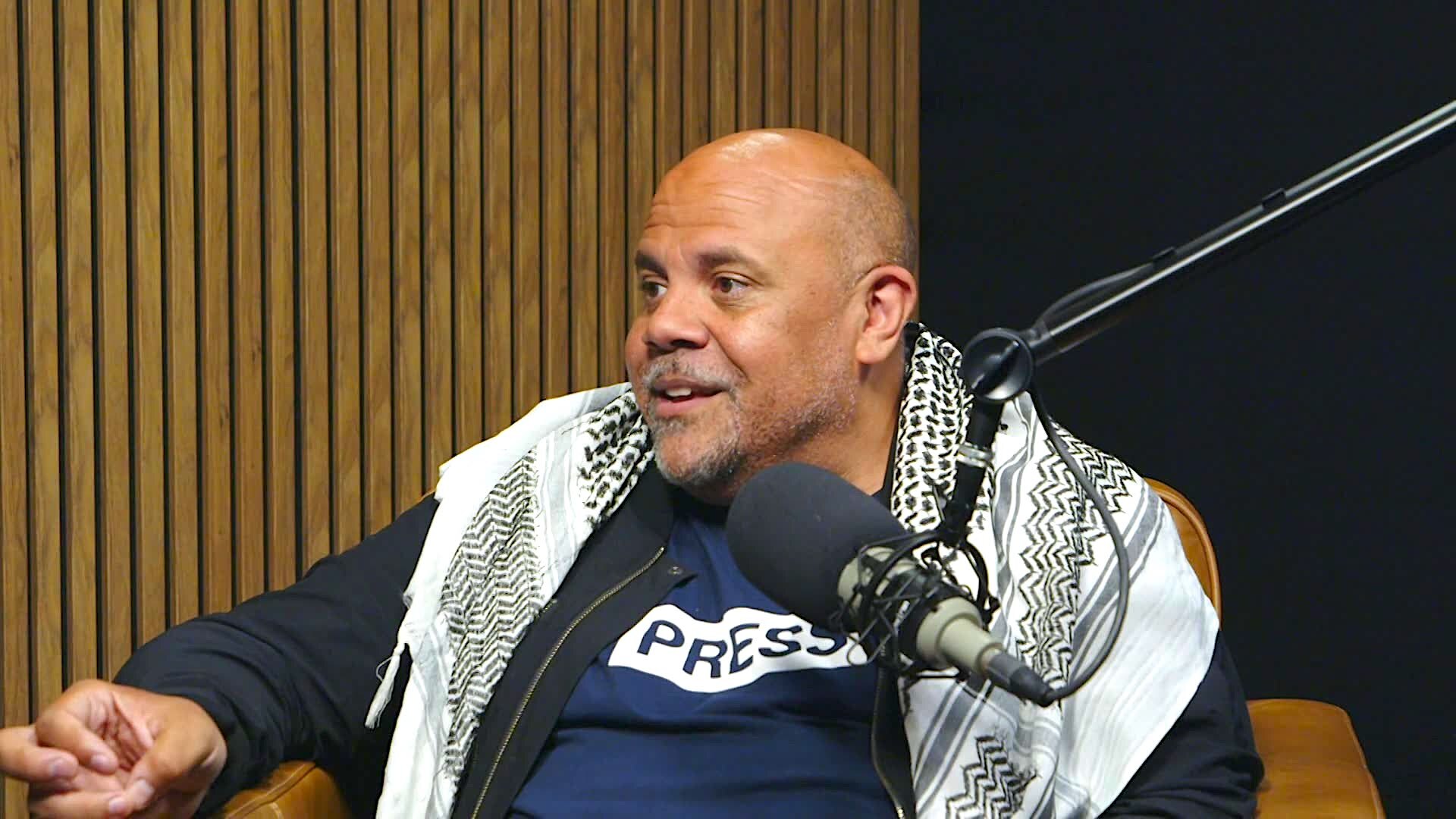
Find Working People wherever you get your podcasts… or sign up to get the latest TRNN stories in your inbox.
We sit down with Dr. Steven Thrasher to discuss his new book, The Overseer Class, how contemporary policing and managerial practices trace roots to antebellum plantations, and why Dr. Thrasher was effectively pushed out of academic teaching after defending students during the Palestine encampment movement in 2024.
Guest
Steven W. Thrasher, PhD, is the author of The Overseer Class: A Manifesto and The Viral Underclass: The Human Toll When Inequality and Disease Collide. His writing and scholarship focus on race, gender, public health, and media. He holds the Daniel Renberg Chair for Social Justice in Reporting at Northwestern’s Medill School of Journalism and is on faculty at Northwestern’s Institute of Sexual and Gender Minority Health and Wellbeing. His work has appeared in the Guardian, Atlantic, New York Times, Scientific American, Literary Hub and academic journals.
Credits
Studio production / Post-production: David Hebden
Transcript note
This is a rushed transcript and may contain errors. It will be updated when possible.
Conversation summary (neutral, condensed)
– Thesis and scope: Dr. Thrasher describes the “overseer class” as people from various backgrounds who enforce and police labor, culture, and institutional boundaries on behalf of those with greater power. The term links historical plantation overseers to modern managers, certain policing roles, and institutional actors who maintain control through surveillance, discipline, and threats to livelihood or family stability.
– Class dynamics and intent: The book treats overseer behavior as a structural phenomenon that persists regardless of individual intent. People may join roles that require coercive enforcement for economic or social reasons; class structures then incentivize and reproduce those behaviors.
– Historical analogy: Thrasher uses plantation overseers as a starting point to explain how techniques of control—threats to family, employment, housing, and bodily autonomy—translate into modern workplaces, correctional institutions, and policing. He emphasizes that the analogy is meant to clarify lineage and mechanisms rather than to equate situations literally.
– Cultural examples: The interview references the TV series Severance as an illustration of workplace severance of personal identity and the use of overseer figures who monitor and manipulate workers. Thrasher argues cultural texts can reveal how power operates in intimate and bureaucratic ways.
– Policing and corrections: Recruitment for police and corrections often targets nonwhite applicants and offers wages that outpace other public-service jobs, reflecting an overseer dynamic where marginalized people are hired to control marginalized communities. This pattern reinforces racialized power relationships.
– Workplaces and ERGs: Employee Resource Groups and other diversity initiatives can be co-opted. Thrasher describes cases where organizers and activists within corporations have been surveilled, undermined, or fired by managers or overseers acting to protect institutional interests rather than worker needs.
– Academia and blacklisting: Thrasher recounts incidents beginning at NYU and later at Northwestern in which institutional leaders sought to limit what faculty could say about Israel and related protests. When campus encampments emerged in 2024, he joined colleagues to ensure a faculty presence and stood between police and students at Northwestern; he was injured and later faced administrative and political pressure. Congressional attention to his actions intensified the consequences; he says he has been suspended from teaching and finds his academic career constrained. He describes this as another example of overseer dynamics within higher education—trustees, administrators, and donors shaping policy and disciplining dissent.
– What the encampments revealed: According to Thrasher, student encampments exposed how universities operate at the intersection of public funding, philanthropy, and corporate interests, often functioning as laboratories for defense contractors, tech, and public opinion work. Encampments also showed solidarities across faiths and backgrounds and challenged the division between campus and surrounding communities.
– Moral choices and survival: Both Thrasher and the interviewer reflect on how people are often placed in roles that compel them to act against others—warehouse managers, temporary workers, corrections officers, and others. They argue naming these structures and the decisions individuals face can help people resist being turned into overseers and can open avenues for collective change.
– Conclusion and aims of the book: Thrasher says his goal is to provide language and recognition for people who have experienced these dynamics, to help readers name the problem and consider alternatives. He emphasizes solidarity, the importance of identifying moments when individuals can act differently, and the potential for healing when people share their stories.
About The Real News Network
Independent · Nonprofit · Nonpartisan
TRNN produces reporting focused on stories often neglected by corporate media. No paywalls, no advertisers, no billionaire owners; funded by viewers and supporters.
Topics covered (examples)
– Workers & labor rights
– U.S. politics & democracy
– Palestine & global justice
– Economic inequality
– Media accountability
Support TRNN
Make a donation (monthly, one-time, yearly). The Real News Network is a 501(c)(3) nonprofit; donations are tax-deductible, secure, and may be canceled anytime. Every dollar goes directly toward independent reporting.
Republishing and license
TRNN offers republishing options under a Creative Commons license; consult the site for details.
End note
The full conversation and a longer transcript are available from TRNN. This summary condenses the key points of the interview with Dr. Steven Thrasher and aims to present them in a clear, neutral tone.
Leave a Reply
You must be logged in to post a comment.